⚠️Mattress/rug order pricing information important !
Shows
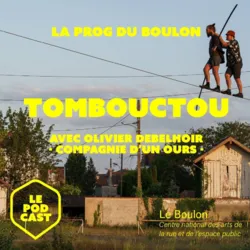
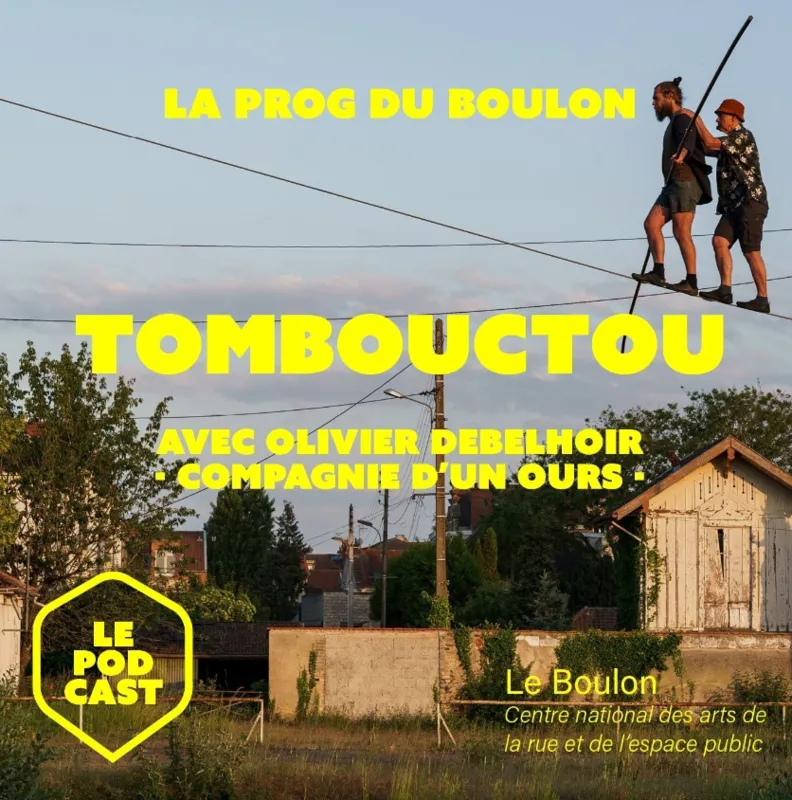
Ombouctou, a father and his son – A tightrope walking circus show by Compagnie d'un Ours
From 23 may at 18:00 to 28 september 2026 at 18:00
Timbuktu
The Edge of Bruyères-le-Châtel (Essonne) Le 23 may 2026 at 18:00
The Edge of Bruyères-le-Châtel (Essonne) Le 24 may 2026 at 18:00
Saint-Luc Institute, Chaussée de Tournai, Ramegnies-Chin (Belgium) Le 20 september 2026 at 16:00
Tujac Sports Field, Brive-la-Gaillarde (Corrèze) Le 27 september 2026 at 18:00
Tujac Sports Field, Brive-la-Gaillarde (Corrèze) Le 28 september 2026 at 18:00
Belgique
Institut Saint-Luc
Chaussée de Tournai
7520 Ramegnies-Chin
Belgique
France
Plaine des Jeux de Tujac
19100 Brive-la-Gaillarde
Corrèze
France
La Lisière
Lieu de création pour les arts de la rue
91680 Bruyères-le-Châtel
Essonne
Institut Saint-Luc
Chaussée de Tournai
7520 Ramegnies-Chin
Belgique
France
Plaine des Jeux de Tujac
19100 Brive-la-Gaillarde
Corrèze
France
La Lisière
Lieu de création pour les arts de la rue
91680 Bruyères-le-Châtel
Essonne
France
Price
The Edge : Gratuit sur réservation
The Brive imprint : Gratuit sur réservation (jauge limitée)
Prato Belgium : Plein tarif : 14 €
Prato Belgium : Tarif abonnés Prato : 10 €
Timbuktu is a contemporary circus show that is at once breathtaking, intimate, and profoundly human, conceived by Olivier Debelhoir and the Compagnie d'un Ours. Blending tightrope walking, theatre, autobiographical narrative, and poetry, this creation suspends time, inviting the audience to share a family adventure where each step on the wire becomes a reflection on transmission, memory, aging, and filial love.
It all begins with a family story. Olivier Debelhoir takes his own father, Pierre Debelhoir, now a retired doctor in his seventies, on an extraordinary expedition. Together, they climb onto a tightrope stretched twelve meters above the ground. One is a professional tightrope walker, accustomed to heights and imbalance. The other discovers this world with all the fragility, caution, and experience of a life already well-lived. A sincere dialogue unfolds between them, sometimes funny, sometimes moving, where each progresses at their own pace, carried as much by the wire as by their words.
The show's starting point is the story of René Caillié, the first European to enter and leave Timbuktu, the mythical "pearl of the desert" in Mali, alive. Hailing from the same village as Olivier's father, Mauzé-sur-le-Mignon, this explorer became a local hero. Yet, behind this epic tale lies a more complex reality. Timbuktu evokes great conquests, but also the wounds of colonization and the European perspective on a world often romanticized. Olivier Debelhoir doesn't seek to simply recount a page of history; he uses it as a mirror to examine the narratives we inherit, those we pass on, and those we choose to reinvent.
Through this ascent, the performance also becomes a personal quest. Olivier revisits his father's childhood memories, recalling when tightrope walkers would set up their cables in the village square during festivals. These images of the past intertwine with dreams of exploration, tales of adventure, and family recollections. Everything suddenly seems to fall into place: his native village, the tightrope walkers, René Caillié, father and son. A new expedition can begin.
The two performers wear microphones that allow the audience to hear every exchange, every breath, every hesitation. This close sonic proximity creates a surprising intimacy despite the dizzying height at which they move. The performance thus gives the impression of witnessing a private conversation suspended in mid-air. Silences become as important as words, while the slightest step on the cable becomes a genuine risk.
Throughout this journey, Timbuktu delicately explores family ties, intergenerational transmission, the passage of time, old age, and the place we give to our parents as they grow older. Olivier also evokes a tradition recounted in Mali, according to which some elders were once abandoned on a mountaintop to die. This striking image fuels a universal reflection on our relationship with old age, dependency, and how each society cares for its elders.
The show is imbued with understated humor, profound tenderness, and disarming sincerity. The father still dreams of achieving this extraordinary climb, while the son, more clear-sighted, knows that they may find "only sand" at the end of the journey. Yet, he accepts this shared trek, because some adventures are more valuable for the journey itself than for the destination. Each moves forward with their fears, doubts, memories, and limitations, never seeking to prove anything. This balance then becomes a beautiful metaphor for the relationship between a father and his son.
On an artistic level, Olivier Debelhoir has pursued a unique path for several years, blending circus arts, writing, and personal narrative. Initially a street juggler and tightrope walker, then trained at the Marseille Circus School as a porter on an acrobatic bicycle, he subsequently developed a practice enriched by tai chi. A circus artist, acrobat, and intimate musician, he creates shows where spoken word plays as important a role as physical prowess. Following *Un soir chez Boris* (2015), *L'Ouest loin* (2017), and *Une pelle* (2020), *Timbuktu* marks a new stage in his career by inviting his own father to share the stage.
The staging is based on a sensitive script conceived by Olivier Debelhoir, enriched by the co-writing and outside perspectives of François Hien and Ophélie Ségala. The performance is led by Olivier Debelhoir and Pierre Debelhoir, with Michaël Philis as stage manager, Julien Michenaud as sound engineer and rigger, Nicolas Ligeon and Pauline Favaloro as production administrators, Julien Couzy (or Fleur Lefèvre, depending on the tour) as distributor, and Mathieu Hibon as tightrope coach. The production is by Ballet Cosmique.
The show also benefits from the support of many major partners in contemporary circus, including Le Sirque – National Circus Centre of Nexon, l'Agora – National Circus Centre of Boulazac, la Scène Nationale de Bourg-en-Bresse, La Brèche – National Circus Centre of Cherbourg, le Théâtre du Vellein, La Cascade – National Circus Centre of Bourg-Saint-Andéol, Le Champ de Foire de Saint-André-de-Cubzac, Le PALC – National Circus Centre of Châlons-en-Champagne, as well as the Auvergne-Rhône-Alpes Region, which supports the project as part of its aid for experimentation.
Suitable for ages 8 and up, and lasting 45 minutes, Tombouctou is an experience as spectacular as it is moving. Suspended twelve meters above the ground, a father and son advance side by side, supported by a wire, memories, and profoundly human words. Blending humor, vertigo, emotion, and poetry, Compagnie d'un Ours presents a unique work where the circus becomes a language to tell the story of family ties, the legacy of generations, and the courage to move forward together, even when each is looking in a different direction.
It all begins with a family story. Olivier Debelhoir takes his own father, Pierre Debelhoir, now a retired doctor in his seventies, on an extraordinary expedition. Together, they climb onto a tightrope stretched twelve meters above the ground. One is a professional tightrope walker, accustomed to heights and imbalance. The other discovers this world with all the fragility, caution, and experience of a life already well-lived. A sincere dialogue unfolds between them, sometimes funny, sometimes moving, where each progresses at their own pace, carried as much by the wire as by their words.
The show's starting point is the story of René Caillié, the first European to enter and leave Timbuktu, the mythical "pearl of the desert" in Mali, alive. Hailing from the same village as Olivier's father, Mauzé-sur-le-Mignon, this explorer became a local hero. Yet, behind this epic tale lies a more complex reality. Timbuktu evokes great conquests, but also the wounds of colonization and the European perspective on a world often romanticized. Olivier Debelhoir doesn't seek to simply recount a page of history; he uses it as a mirror to examine the narratives we inherit, those we pass on, and those we choose to reinvent.
Through this ascent, the performance also becomes a personal quest. Olivier revisits his father's childhood memories, recalling when tightrope walkers would set up their cables in the village square during festivals. These images of the past intertwine with dreams of exploration, tales of adventure, and family recollections. Everything suddenly seems to fall into place: his native village, the tightrope walkers, René Caillié, father and son. A new expedition can begin.
The two performers wear microphones that allow the audience to hear every exchange, every breath, every hesitation. This close sonic proximity creates a surprising intimacy despite the dizzying height at which they move. The performance thus gives the impression of witnessing a private conversation suspended in mid-air. Silences become as important as words, while the slightest step on the cable becomes a genuine risk.
Throughout this journey, Timbuktu delicately explores family ties, intergenerational transmission, the passage of time, old age, and the place we give to our parents as they grow older. Olivier also evokes a tradition recounted in Mali, according to which some elders were once abandoned on a mountaintop to die. This striking image fuels a universal reflection on our relationship with old age, dependency, and how each society cares for its elders.
The show is imbued with understated humor, profound tenderness, and disarming sincerity. The father still dreams of achieving this extraordinary climb, while the son, more clear-sighted, knows that they may find "only sand" at the end of the journey. Yet, he accepts this shared trek, because some adventures are more valuable for the journey itself than for the destination. Each moves forward with their fears, doubts, memories, and limitations, never seeking to prove anything. This balance then becomes a beautiful metaphor for the relationship between a father and his son.
On an artistic level, Olivier Debelhoir has pursued a unique path for several years, blending circus arts, writing, and personal narrative. Initially a street juggler and tightrope walker, then trained at the Marseille Circus School as a porter on an acrobatic bicycle, he subsequently developed a practice enriched by tai chi. A circus artist, acrobat, and intimate musician, he creates shows where spoken word plays as important a role as physical prowess. Following *Un soir chez Boris* (2015), *L'Ouest loin* (2017), and *Une pelle* (2020), *Timbuktu* marks a new stage in his career by inviting his own father to share the stage.
The staging is based on a sensitive script conceived by Olivier Debelhoir, enriched by the co-writing and outside perspectives of François Hien and Ophélie Ségala. The performance is led by Olivier Debelhoir and Pierre Debelhoir, with Michaël Philis as stage manager, Julien Michenaud as sound engineer and rigger, Nicolas Ligeon and Pauline Favaloro as production administrators, Julien Couzy (or Fleur Lefèvre, depending on the tour) as distributor, and Mathieu Hibon as tightrope coach. The production is by Ballet Cosmique.
The show also benefits from the support of many major partners in contemporary circus, including Le Sirque – National Circus Centre of Nexon, l'Agora – National Circus Centre of Boulazac, la Scène Nationale de Bourg-en-Bresse, La Brèche – National Circus Centre of Cherbourg, le Théâtre du Vellein, La Cascade – National Circus Centre of Bourg-Saint-Andéol, Le Champ de Foire de Saint-André-de-Cubzac, Le PALC – National Circus Centre of Châlons-en-Champagne, as well as the Auvergne-Rhône-Alpes Region, which supports the project as part of its aid for experimentation.
Suitable for ages 8 and up, and lasting 45 minutes, Tombouctou is an experience as spectacular as it is moving. Suspended twelve meters above the ground, a father and son advance side by side, supported by a wire, memories, and profoundly human words. Blending humor, vertigo, emotion, and poetry, Compagnie d'un Ours presents a unique work where the circus becomes a language to tell the story of family ties, the legacy of generations, and the courage to move forward together, even when each is looking in a different direction.
3€00
2€00
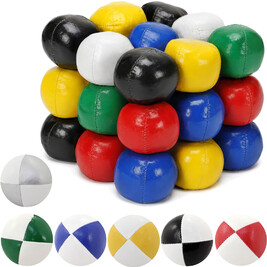
Softball 70 or 120g
The best-selling toy for beginners! Doesn't roll away, soft to the touch, easy to grasp. Perfect for developing motor skills and confidence.
2€50
2€00
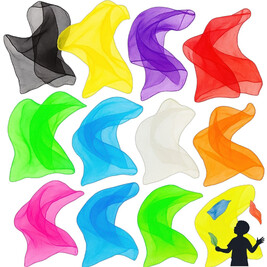
NetJuggler Juggling Scarf
Ideal for children aged 4 and up to discover the sport. Slow flight: understanding rhythm and developing coordination.
4€00
3€00
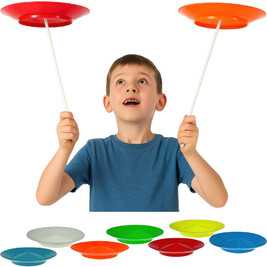
Soft Chinese plate + chopsticks
Essential for beginners! Made of unbreakable, flexible plastic, ideal for success and confidence. Perfect for schools.


4€00
3€20
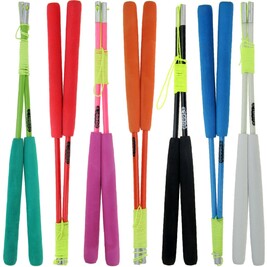
Star beanbag
Ergonomic 6-panel design for a better grip. Robust, ideal for all levels and for developing dexterity.
24€50
18€50
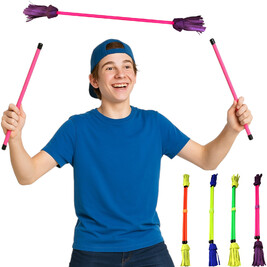
NEO flower stick set
Full silicone grip for a perfect hold. The complete kit for learning safely and without slipping.