Choosing the Right Diabolo: An Expert Guide
NetJuggler has been equipping circus schools and professional jugglers for years. Whether you are looking for your first diabolo for beginners or a competition model (Henrys, Taibolo, Hyperspin), We guarantee the same high standards of quality. Here are the key technical points to avoid making a mistake.
1. Choose the Size (Inertia)
Recommended for beginners and children (under 8-10 years old). Being more compact and lighter, they cause less fatigue in the arms and wrists when learning the basics.
The world standard in juggling. Their large wingspan provides better inertia. (they run longer without restarting) and maximum stability. Recommended for teens, adults and professionals.
2. Choosing the Axis (Mechanics)
The central axis of the domes. Essential for learning technical precision and accelerations. This is the model required by most circus schools to start properly.
The central part rotates freely. Maintains speed 2 to 6 times longer . Facilitates learning and allows for figures impossible on a fixed axis (Vertax). Ideal for leisure and rapid progression.
Like all professional equipment, our diabolos are sold bare (alone). Consider adding a pair of diabolo sticks (Carbon, Aluminum or Fiber) to your order.


| Family / Type | Ideal Audience | Technical Advantages | Limitation / Drawback | Recommended Use |
|---|---|---|---|---|
| Criterion 1: Size | ||||
| Diabolos Mediums (100mm - 115mm) |
Children (under 10 years old) | Lightweight . Less tiring for small arms. | Less inertia (stops faster). | Introduction, Discovery. |
| Large Diabolos (> 120mm) |
Teens / Adults / Professionals | High inertia . Very stable and visual. | Heavier for very young children. | Universal standard (Leisure & Stage). |
| Criterion 2: Mechanics (The Axis) | ||||
| Fixed Axis (Standard) |
Circus Schools / Purists | Learning technical rigor and acceleration. | The diabolo brakes if you don't activate it. | Learn the basics, practice technique with several diabolos at the same time. |
| 1 Ball Bearing (Simple) |
Leisure / Smart Beginner | Rotates much longer ( x2 to x3 ) than a fixed axis. Immediate ease of use. | Less stable than a triple bearing. | Immediate pleasure, Long figures. |
| Triple Bearings (High-end) |
Experts / Enthusiasts |
Rotation up to 6x longer . Increased durability: the load is distributed over 3 bearings, which relieves stress on the axle and internal system. |
Higher budget. | Intense gameplay, Vertax, perfect fluidity. |
Diabolo videos:
Here is a diabolo video of Etienne Chauzy, one of the most talented diabolo players , during his first open stage at the Carvin juggling convention in 2010. Etienne was 15 years old at the time.

A big thank you to Donald for the video and thank you Etienne for lending us these impressive images!
Diabolo Frequently Asked Questions
What length of string should I choose?
• Too short: the diabolo will touch the ground or your body.
• Too long: you will not be able to lift the diabolo high enough and your arms will be too far apart.
Fixed axle or bearings for beginners?
• The Fixed Axis is the "academic" choice. It requires constantly accelerating the diabolo, which teaches the correct techniques.
• The ball bearing diabolo is more "rewarding". The diabolo spins on its own for a very long time, which gives you more time to perfect your tricks. It's often more fun for recreational use.
Which chopsticks to choose: Wood, Aluminum or Carbon?
• Aluminium: Rigid, thin and very strong. Perfect for "Grinds" (sliding the diabolo on the stick).
• Carbon: The best. Ultra-light, responsive, absorbs shocks. The choice of pros.
• Fiberglass: Excellent value for money, very robust and slightly flexible. Because the sticks are very light, you really feel the diabolo, you feel close to it.
Best selling of the moment

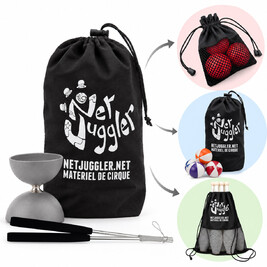
Ball bag, diabolo or clubs

Anodized Aluminum Wands

Henrys 10m twine bag

Diabolo Cyclone Quartz V2
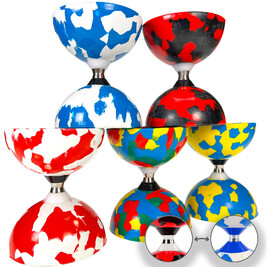
Diabolo Jester

