Clowns Without Borders France: The art of clowning in the service of humanitarian aid
For children, we've created an adapted version of this article: 🎈 Clowns Without Borders: when humor becomes a superpower to change the world 🌍
Founded nearly three decades ago, Clowns Without Borders France is distinguished by a simple yet powerful idea: to put the art of clowning and live performance at the service of humanitarian action. Like other "borderless" NGOs, this initiative mobilizes volunteer artists to bring laughter, hope, and comfort to the most vulnerable populations, especially children, in crisis situations. This article offers an in-depth look at the history, mission, and actions of Clowns Without Borders France, exploring its humanitarian and cultural impact, its internal workings, its numerous partnerships, and its links with the international Clowns Without Borders network. A well-researched, factual, and committed perspective on "the art of clowning in the service of humanitarian aid."
History of Clowns Without Borders France

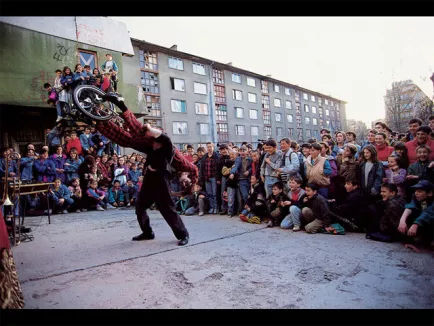
The story of Clowns Without Borders France begins in the heart of the conflicts of the 1990s. In February 1993, the Catalan clown Tortell Poltrona was invited to perform in makeshift schools at a refugee camp in Croatia, during the war in the former Yugoslavia. Deeply affected by the experience and aware of the power of laughter in times of crisis, upon his return he founded the association Payasos Sin Fronteras (Clowns Without Borders) in Spain, laying the foundation for a humanitarian clown movement. During a Franco-Spanish tour organized that same year in Croatia, Tortell Poltrona encouraged his colleague and friend, the French clown Antonin Maurel , to establish a similar organization in France. The association Clowns Without Borders France was thus born in December 1993 in Paris, at the Villa Marcès (home of the Maurel family) which hosted its first steps. Antonin Maurel surrounded himself with a few passionate close friends (including several members of his family as well as artists such as Malik Nahassia or Sidonie Pigeon) to build this unprecedented initiative in France.
The early years of Clowns Without Borders France were marked by the pioneering enthusiasm of its founders. Very quickly, the idea resonated beyond borders: as early as 1994, a joint mission of Canadian and French artists went to Bosnia-Herzegovina to extend the initial momentum born in Croatia.
Throughout the 1990s, branches opened in other countries, such as Canada, Sweden, and the United States, inspired by the Spanish and French models. In France, the association consolidated its foundations: it was registered as a non-profit organization under the 1901 law from its inception.
Its seven co-founders remained involved for more than twenty-five years in the governance and management of the structure.
Since then, Clowns Without Borders France has continued to intervene "all over the world to provide moral support through live performance" to children and populations in distress. Three decades later, it has established itself as a benchmark in "humanitarian aid through laughter," drawing on a heritage rooted in circus and solidarity.
Mission and values of Clowns Without Borders
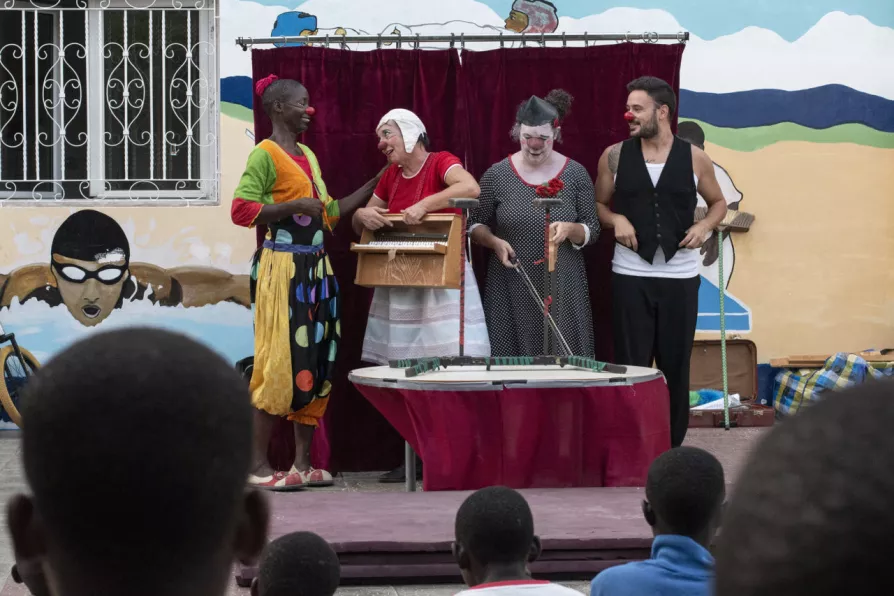
Clowns Without Borders France defines itself as an international solidarity arts organization whose mission is to provide psychosocial support to populations affected by humanitarian crises or living in extreme poverty, primarily children. In practical terms, its artists use clowning, circus, magic, music, and dance performances to bring back "the joy of smiling" to children who have experienced conflict, forced displacement, or disasters. The aim is to offer a moment of respite and joy to the most vulnerable, helping them to rebuild their emotional well-being. All of the organization's performers are professional artists who volunteer their time to this cause for the duration of their missions. Clowns Without Borders France always works in close partnership with local associations or NGOs already present on the ground, integrating its artistic work within a coherent humanitarian framework.
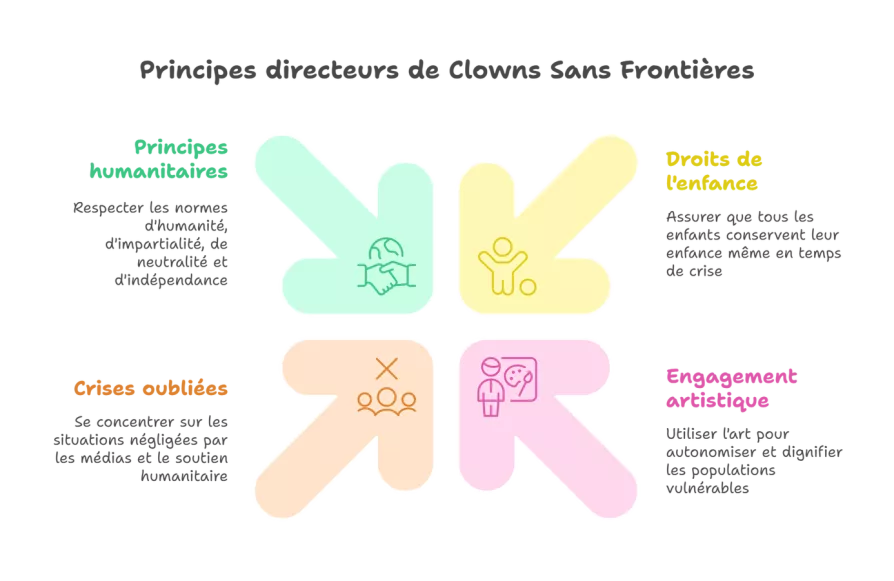
The values of Clowns Without Borders France are expressed in a clear advocacy and ethical framework. The organization is committed to upholding children's rights and considers access to art and culture a fundamental right. Its actions are guided by strong principles that shape its methods of intervention and public discourse:
- The right to childhood for all, at any age – In many crises, children's rights (education, play, carefree joy) are violated daily. Clowns Without Borders France affirms the urgent need to defend the right to laugh, play, and imagine , to give every child back a part of their childhood, even amidst hardship.
- The volunteer commitment of professional artists – “Putting their art at the service of the most vulnerable” – is a core belief of the association. Convinced that access to art and culture contributes to emancipation and human dignity, Clowns Without Borders employs only trained artists who volunteer their services, guaranteeing authenticity and generosity in their work.
- Prioritizing Forgotten Crises – True to its name, Clowns Without Borders aims to overcome barriers, including those of media indifference. The organization prioritizes interventions in underreported situations, using its unique approach to draw the attention of the general public, the media, and other organizations to "forgotten crises."
- Respect for humanitarian principles – Although atypical, the work of Clowns Without Borders France aligns with the founding principles of humanitarian aid: humanity (priority given to the needs of the most vulnerable), impartiality (aid without discrimination), neutrality, and independence from political or religious interests. These ethical guarantees ensure that shared laughter is never used for propaganda, but rather as a universal humanitarian cause.
In short, Clowns Without Borders France's vision revolves around a central message: "Laughter, play, and imagination are not luxuries, but essential needs," even in emergency situations. The organization's advocacy promotes the right to childhood worldwide, believing that access to art and culture is a fundamental human right.
Clowns Without Borders France thus asserts that cultural rights are on par with basic needs: "We maintain that cultural rights are among the fundamental rights and needs of the individual," reads its manifesto. Its approach is resolutely civic and activist, emanating from members of civil society (the artists themselves) who are committed to working alongside vulnerable populations to defend their dignity. This commitment translates into a specific method of action, based on listening to the realities on the ground, collaborating with humanitarian and artistic partners, and striving to ensure the long-term impact of each project beyond the performance itself.
Artistic interventions in the field
Internationally: camps, crisis zones and forgotten communities
Since 1993, Clowns Without Borders France has deployed its activities around the world in response to a variety of crises. More than 40 countries and territories have welcomed the association's clowns, from Africa to Asia, including the Middle East and Eastern Europe. Historically founded in refugee camps in the Balkans, the NGO has since carried out missions in contexts as diverse as: isolated villages in Senegal , impoverished neighborhoods in Madagascar , camps for displaced persons in Ethiopia , disaster areas after the tsunami in Southeast Asia , the Palestinian territories in the West Bank , and orphanages in Romania , to name just a few. In each case, the aim is to intervene as closely as possible to populations affected by armed conflict, natural disasters, or extreme poverty , in order to provide them with moral support through laughter.
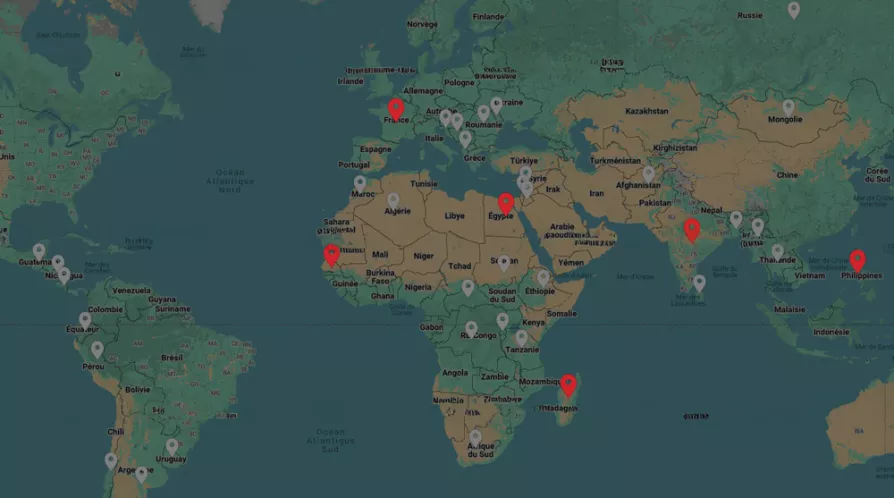
Clowns Without Borders France generally operates after the immediate emergency phase , complementing traditional humanitarian aid. As its executive director, Noémie Vandecasteele, points out, the organization intervenes "in a second phase," once basic needs (food, medical care, shelter) have been met, and people can truly enjoy a show.
The challenge then becomes creating a space of shared joy in often traumatic environments. The forms these missions take vary: street performances in refugee camps, village tours in war zones, art workshops in centers for demobilized child soldiers, etc. For example, in 2005 in Afghanistan , the teams organized shows and clown workshops in Kabul for children who had grown up amidst violence and exile.
In 2013 in the Philippines , a tour was conducted with street children in Manila, bringing music and clowning to neighborhoods where children's laughter is rare. More recently, in the fall of 2023, Clowns Without Borders France scheduled interventions in Turkey (with refugee and disaster-stricken families) as well as in Senegal , while an innovative mission was planned in a prison for minors and women in Cambodia – proof of the diversity of contexts involved.
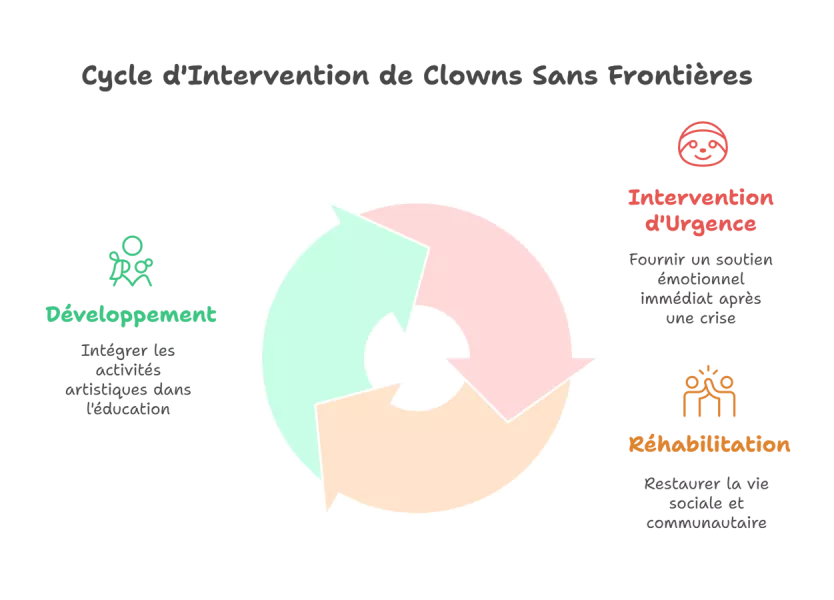
Clowns Without Borders' areas of action cover several stages of humanitarian intervention:
- In emergency situations , the association offers immediate performances in camps and disaster areas to support the psychosocial resilience process alongside material aid. These performances act as an initial emotional balm , allowing children and their families to breathe and rebuild themselves internally after the shock of war or disaster.
- During the rehabilitation and recovery phase , clowns work with refugee or displaced populations over the medium term. Tours are organized in camps or host communities to support the return to a normal and sustainable social life. Laughter becomes a tool to help uprooted people rebuild their lives and strengthen their ability to move forward.
- In a development context , Clowns Without Borders implements artistic activities for excluded or incarcerated children (street children, minors in prison, and young people from marginalized minorities). These projects are always carried out in partnership with local artists. The objective is twofold: to integrate children's rights (leisure, expression, creativity) into local education and development programs, and to encourage local artistic talent to continue this work once the mission is completed. For example, in Madagascar , where Clowns Without Borders has a long history of working, teams organize workshops with Malagasy musicians and actors so that they, in turn, can perpetuate the activities with disadvantaged children.
Whatever the specific form of the intervention, a Clowns Without Borders France performance is designed to be participatory and context-appropriate . The acts are often created on-site, drawing on exchanges with the community and local culture. The association's artists seek to involve the audience – especially children – in the clowning, through laughter, songs, and spontaneous interactions, so that everyone becomes an active participant in a shared experience. It is not uncommon for local artists to join the temporary troupe created for a specific mission, resulting in unique collaborative creations. This intercultural co-creation strengthens the impact of the performances: it ensures better audience reception (as people recognize themselves in the cultural references used) and leaves a lasting legacy by training local partners in the techniques of humanitarian clowning.
In France: serving the most vulnerable and raising awareness
While most of Clowns Without Borders France's work takes place abroad, the organization also operates within France , focusing on local solidarity and development education. From its earliest years, Clowns Without Borders France has worked with vulnerable populations in France, such as children from homeless families in the Paris region. Today, the organization leads artistic projects with marginalized communities across France, often in partnership with social service organizations.
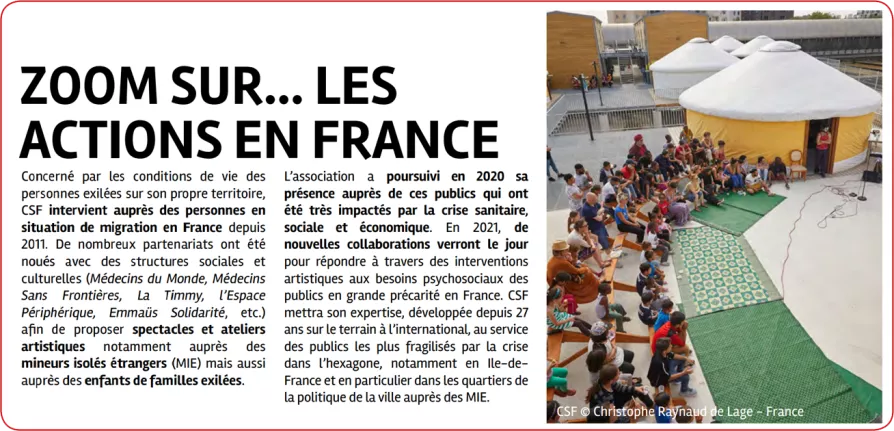
A key focus is working with migrants and refugees in France . For example, shows and workshops are regularly organized in emergency shelters for migrant families (CHUM) in the Île-de-France region. In these places where families who have fled war or poverty are trying to rebuild their lives, clowns offer children a time for play and laughter that helps them overcome the trauma of exile. In 2023, a series of clowning workshops took place at the CHUM in Ivry-sur-Seine (Val-de-Marne): for several days, refugee children were introduced to circus arts and put on a short show on the theme of holidays, which they proudly presented to their parents and friends. The joyful faces and bursts of laughter echoing through these usually austere centers illustrate the impact of these interventions.
Clowns Without Borders France also collaborates with organizations working with residents of slums and squats in France . In Seine-Saint-Denis, for example, the organization led clown workshops with young people supported by the NGO Les Enfants du Canal , as part of a program to integrate young adults from slums. These workshops allowed young volunteers, often from Roma migrant communities, to become active participants in an artistic project: trained in clowning by the CSF team, they created a show for younger children in these disadvantaged neighborhoods. This approach not only promotes access to culture for marginalized populations but also empowers these young people as community organizers and full-fledged citizens.
Finally, Clowns Without Borders France carries out a mission to raise awareness among the French public about children's rights and international solidarity. The organization hosts events, photo exhibitions, screenings, and testimonials to publicize its work and, through it, the plight of children in forgotten crises. For example, campaigns like the "March of Noses" —a street event bringing together artists and citizens—have been conducted to draw attention to the cause of children's rights worldwide, involving dozens of cultural partners in France. These communication initiatives, often playful and participatory, extend the work done on the ground by inviting the general public to reflect on the power of laughter and art in the face of human suffering.
A humanitarian and cultural impact
After 30 years, Clowns Without Borders France can measure the multifaceted impact of its interventions—humanitarian, psychosocial, and cultural. On a strictly humanitarian level, the organization primarily contributes to the psychological well-being of populations affected by crises. Numerous testimonials gathered after performances confirm that these shared moments of laughter provide children and their parents with "moments of positive emotions and well-being," in the words of Noémie Vandecasteele. Children who had lost their smiles rediscover, if only for an hour, the carefree joy of play. "Laughter and artistic expression allow children to reconnect with positive emotions, to gain perspective on their difficult situation, and to escape their daily lives," explains the Executive Director of Clowns Without Borders France. These moments stolen from the gravity of reality have a "restorative" effect: they help heal invisible traumas and restore vital energy and hope. Humanitarian psychologists now consider this psychosocial support as an essential complement to material aid, particularly to promote the resilience of younger people in the face of the shocks they have suffered.
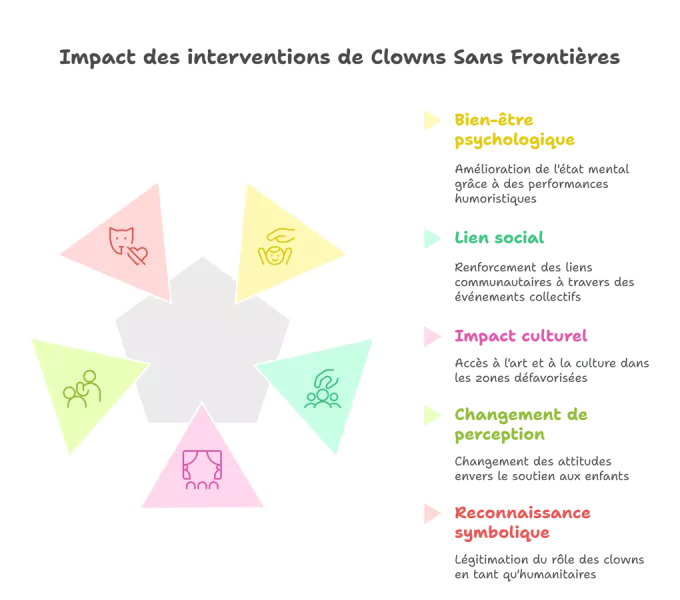
The impact is also felt at the level of social and community cohesion . A clown show in a refugee camp or a disaster-stricken village is not just individual entertainment: it is a collective event that brings together people of all ages and backgrounds around a shared experience. "In refugee camps, for example, where communication between individuals can be difficult, the shows offer a way to create cohesion among all the participants," observes Noémie Vandecasteele. Laughter, a universal language, abolishes linguistic, cultural, and social barriers for the duration of a performance. We then see communities, sometimes divided, coming together to share a moment of humanity. This strengthening of social bonds is invaluable in contexts where cohesion is undermined by adversity. Moreover, by reclaiming public space (the village square, the camp courtyard) and transforming it into a performance stage , the clowns breathe new life into these spaces and recreate a sense of community where fear or withdrawal once reigned. It is not uncommon for local communities to continue using these gathering places for other solidarity or festive activities after the departure of Clowns Without Borders France – a sign that the momentum generated continues.
On a cultural level, Clowns Without Borders' work carries a powerful message: access to art is a universal right and a factor in empowerment . By bringing performances to places where cultural expression is nonexistent or limited (camps, slums, conflict zones), the organization affirms that culture is not a luxury for affluent Westerners, but a fundamental need, even in situations of survival. In doing so, it gives a voice to children and populations often reduced to the status of silent victims. Live performance, interactive by nature, allows participants to express laughter, emotions, and even to join the clowns on stage. For many children, it is their first opportunity to participate in an artistic activity, to feel valued in a way other than through food or school aid. Clowns Without Borders' missions thus leave a lasting cultural imprint : they awaken children's imaginations, sometimes reveal local artistic vocations, and raise awareness among local educational stakeholders about the importance of play and creativity in child development.
The testimony of Isabelle Marie, a partner of the association in Madagascar for 20 years, illustrates this global impact. She recounts how the laughter brought by the clowns "helps transform children's daily problems through the positive messages it conveys." Above all, she notes, "CSF's work isn't just for children; it also leads those in charge of care centers and schools to improve their approaches to children and their parents, for lasting social change." In other words, the clowns' presence sparks an awareness among local adults—educators, social workers, and parents—of the importance of treating children with kindness and attentiveness. This "shift in perspective" on childhood is one of the most profound outcomes of the missions. Furthermore, Isabelle emphasizes the "richness of the exchanges" between the CSF artists and the Malagasy musicians who accompany them: a mutual enrichment that, once again, extends beyond the performance itself.
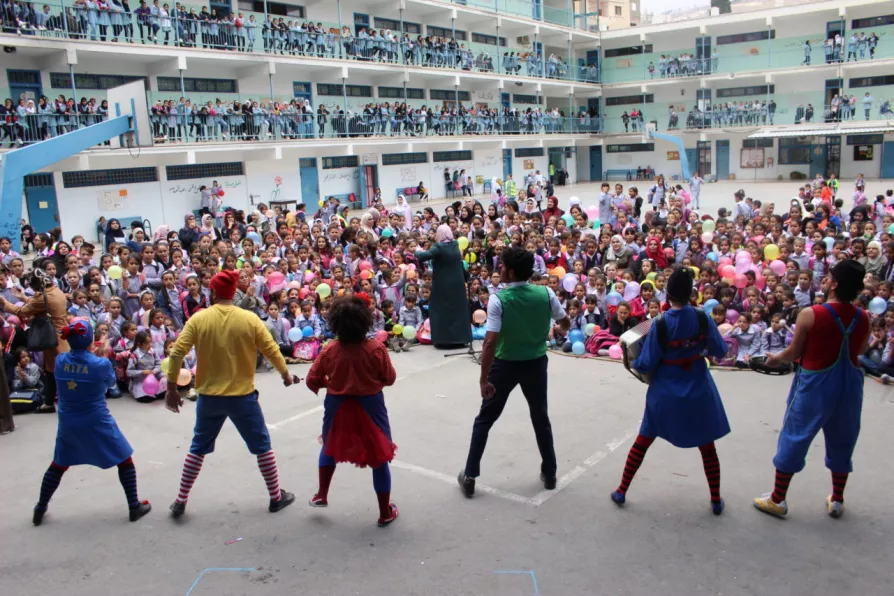
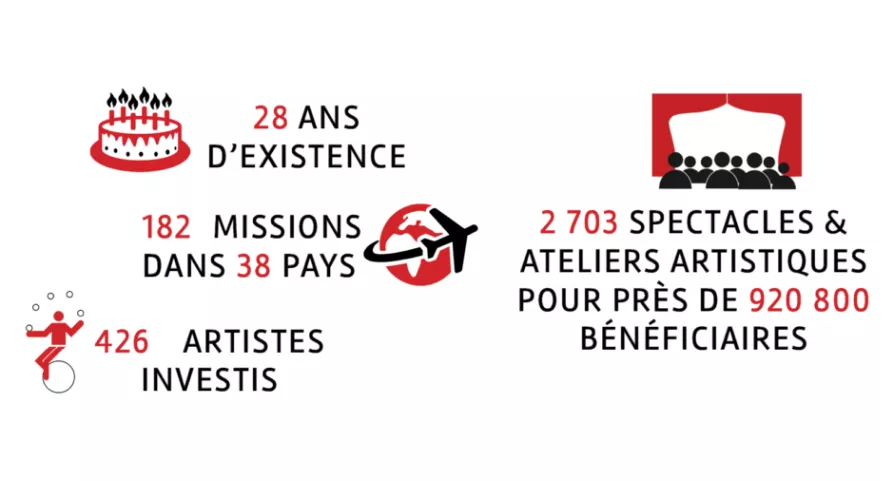
In quantitative terms, the impact of Clowns Without Borders France is significant. For example, in 2016 alone, the organization carried out 12 missions worldwide (representing 117 days of work) reaching over 10,000 children and adults , thanks to the mobilization of 111 volunteer artists who traveled to Madagascar, Egypt, Uruguay, India, Armenia, and other countries. These figures give an idea of the scale of the audience reached . Over three decades, hundreds of thousands of children have been able to laugh and escape for a few moments thanks to humanitarian clowns, in more than 30 different countries. Beyond the direct beneficiaries, the media coverage of some of these interventions has helped raise public awareness . For example, actions carried out in forgotten crises (such as Sahrawi refugee camps or isolated areas in Myanmar) have generated articles and reports, shining a spotlight on situations largely unknown to the general public. We can therefore speak of an advocacy impact: Clowns Without Borders, through the originality of its approach, manages to draw attention to neglected humanitarian causes, thus helping to mobilize other actors or financial support for them.
Finally, on a symbolic and cultural level, Clowns Without Borders has made a significant contribution: legitimizing the role of the clown as a "humanitarian figure." Long perceived solely as a circus entertainer, the clown here finds a new dimension, that of "comforter," to borrow the words of the renowned Howard Buten. The organization has demonstrated that one can be both a clown and a humanitarian, without one compromising the other—quite the opposite. This message has permeated the cultural and humanitarian world: increasingly, art is recognized as a vehicle for resilience in times of crisis, and Clowns Without Borders has been a pioneer in this field. In 2014, the organization received the "Culture for Peace" Prize from the Chirac Foundation, recognizing this alliance of art and solidarity. Other distinctions, such as the Cultural Diversity Prize (2019) and the Pro Bono Trophy (2020), have rewarded its work. But perhaps the best indicator of impact remains the smile of a child who, in the middle of a refugee camp or an improvised hospital room, marvels at a red nose and allows himself to laugh again.
Structure, governance and operation of the association
To accomplish this unique mission, Clowns Without Borders France relies on a lean yet robust organizational structure. Registered as a non-profit organization under the 1901 French law since 1993, it operates according to a classic model of association governance: an annual General Assembly of its members elects a Board of Directors (BoD) responsible for defining the organization's direction and overseeing its management. The BoD, headed by a president, meets regularly to finalize budgets, approve financial statements, and monitor ongoing activities. It delegates day-to-day management to a salaried team based in Paris, recruited by the BoD to implement the organization's mission on a daily basis.
Clowns Without Borders France has a deliberately small permanent team . Currently, it consists of three employees : an Executive Director (who oversees overall management and coordination), a Project Manager (responsible for managing field missions and partnerships), and a Communications and Donor Relations Officer. This small operational team, based in the 19th arrondissement of Paris, manages all activities from headquarters. It handles the logistics of missions abroad (coordination with local partners, recruitment of volunteer artists for each project, and logistical preparation), the development of projects in France, communications (website, social media, press relations), and fundraising. Given the workload, the team is regularly reinforced by civic service volunteers and interns , who provide support on specific tasks (leading workshops in France, administrative assistance, content creation, etc.).
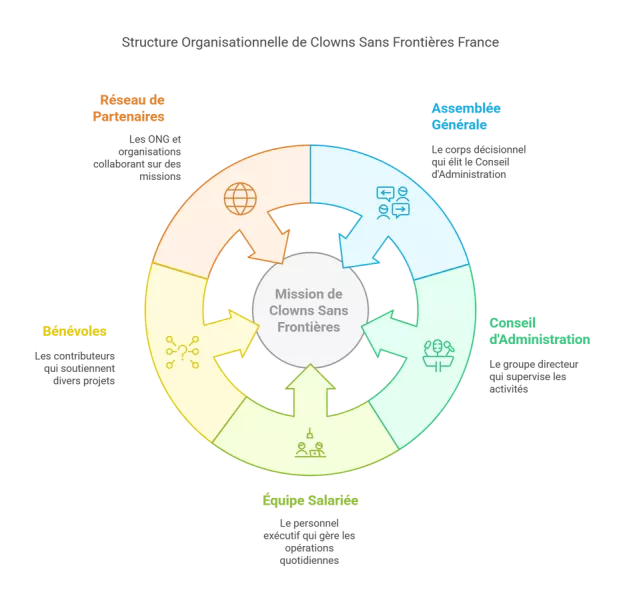
Above all, Clowns Without Borders France could do nothing without its vast network of volunteers . Every year, more than 300 volunteers contribute to the association's work in various ways. First and foremost are the volunteer artists who go into the field: clowns, actors, musicians, acrobats, magicians, and more—all performing arts professionals who dedicate several weeks of their time to participate in a mission without pay (only their expenses are covered). In 2016, for example, 111 volunteer artists went on a humanitarian tour with Clowns Without Borders. This volunteer artistic mobilization has been the association's DNA since its inception and one of its greatest strengths. Volunteers also include those who get involved in France to support the headquarters team or carry out awareness campaigns: organizing events, disseminating information, providing logistical support during campaigns, and offering technical skills (video editing, IT, translation, etc.). This skills-based volunteering allows the association to remain "human-sized," meaning it prioritizes the quality and impact of its projects over the growth of its structure. Volunteering and shared passion are at the heart of its unique identity.
The logistical operation of the missions relies heavily on cooperation with locally established NGOs. Clowns Without Borders France intervenes at the request of local or international partners already present on the ground, or when the organization identifies an urgent unmet need. In practice, this means that missions are often organized in response to an invitation: for example, a medical humanitarian NGO or a children's aid association may contact Clowns Without Borders to complement its work with performances, or a local community may offer to host a touring clown troupe. This approach ensures the relevance of the intervention and its seamless integration into the local context. Before each mission, a rigorous preparation phase is undertaken: discussions with the requesting partner, definition of objectives (target audience, venues, timeline), assembly of a suitable artistic team (relevant linguistic or cultural skills, balance of artistic disciplines), and logistical planning (lightweight performance equipment, transportation, visas, etc.). Once on site, the artists are generally accompanied by a CSF coordinator and the local partner's team, who facilitate contact with the community and authorities and ensure safety conditions. This meticulous work lies behind the spontaneous magic of the performance: as one of the managers explains, "Our approach is based on questioning and listening to the local context, meeting with partners […] We draw on their expertise to design our interventions in a way that complements their work." This operational complementarity is one of the keys to the missions' success.
Internally, Clowns Without Borders France fosters a collaborative and participatory spirit. The small size of the staff team allows for great responsiveness and close relationships with volunteers and artists. Former volunteers often remain connected to the organization, forming a kind of extended family united by their shared experience of the missions. The Annual General Meeting brings together members, volunteers, and partners to review the year, discuss strategic directions, and elect the Board of Directors. For example, in 2020, the organization undertook a strategic review to adapt its operations to the context of the Covid-19 pandemic, in consultation with its members. This adaptability and flexible management enabled it to navigate difficult periods (conflicts preventing certain missions, health crises, etc.) while staying true to its core mission.
Partners and supporters of the association
To carry out its projects around the world, Clowns Without Borders France relies on a broad network of partnerships , reflecting the cross-cutting nature of its work at the intersection of culture and humanitarian aid. These partners fall into several complementary categories:
- NGOs and humanitarian organizations (operational partners) : In the field, Clowns Without Borders frequently collaborates with other NGOs that host them or integrate their shows into their programs. For example, during its missions in the Democratic Republic of Congo, the organization was able to rely on the logistical support of Doctors of the World and the local Red Cross. Similarly, in Guatemala, organizations such as Children Refugees of the World , ATD Fourth World , and Doctors Without Borders (Switzerland) facilitated the arrival of clowns in isolated communities. These partner NGOs see clowns as a way to improve the psychological well-being of their beneficiaries and strengthen the overall effectiveness of aid. Some of these relationships are long-standing: in Madagascar, for instance, Clowns Without Borders has been working for over 15 years in partnership with the NGO Handicap International and the Malagasy association Afafi to organize its tours in remote regions. The association also provides support to programs managed by UNICEF, the Office of the United Nations High Commissioner for Refugees (UNHCR), or Save the Children, depending on the context. This synergy with the traditional humanitarian sector is a cornerstone of its operational approach.
- Public Institutions and International Agencies : Clowns Without Borders France benefits from the support of several institutions, particularly for the funding of its projects. The French Ministry of Culture supports the association as part of its mission to promote cultural rights. The French Development Agency (AFD) , the state's development bank, has also contributed to certain missions and impact studies. French embassies abroad (Madagascar, Senegal, Egypt, etc.) regularly provide financial or logistical support for clown tours in these countries. At the local level, the City of Paris has recognized the association through the Solidev Label, which supports solidarity initiatives, and regional or departmental councils may occasionally subsidize activities in France. On the international stage, Clowns Without Borders International (the global network of which CSF France is a part) is recognized as an official UNESCO partner for the promotion of cultural diversity and the rights of the child (consultative status obtained in 2015). This institutional recognition reinforces the association's credibility in the humanitarian sector.
- Foundations, Patrons, and Socially Responsible Businesses : A significant portion of our resources comes from private generosity, through foundations and corporate sponsors. Among our loyal supporters is the Air France Foundation , which has been committed to CSF for many years to fund missions in Africa. The Pierre Bellon Foundation (founded by the founder of Sodexo) is also a major financial partner. Other corporate and family foundations contribute depending on the project: the Fondation de France, the Hoppenot Endowment Fund, the Wavestone Foundation, the Banque Populaire Rives de Paris Foundation, and others. Certain public agencies or programs can also act as sponsors, such as the Civic Service Agency or Franco-German cultural funds. In parallel, the organization is developing corporate sponsorship through partnerships with SMEs and large companies that support its mission. The socially responsible travel agency Touristra Vacances , for example, is one of our operational partners, providing logistical support. Companies like Procédés Chenel (specializing in set design) support CSF by providing stage equipment. Furthermore, Clowns Without Borders offers businesses a variety of partnership opportunities (rounding up donations, team building activities centered around clowning, etc.) to involve the corporate world in its humanitarian mission.
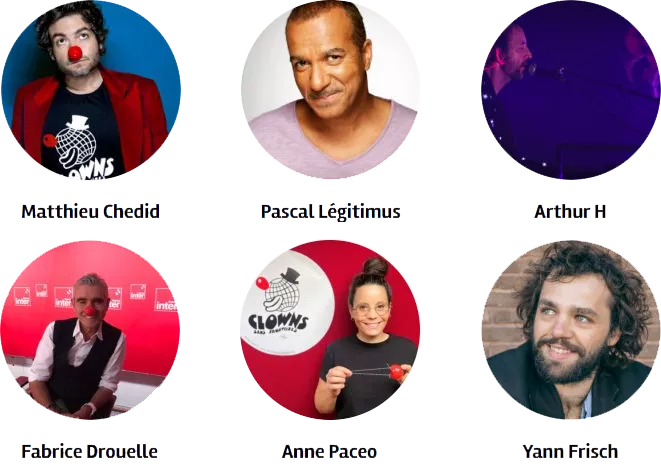
- Artists, personalities, and cultural organizations : Many renowned artists have chosen to sponsor or support Clowns Without Borders France, aware of the impact of its work. Musician Matthieu Chedid (aka -M-), a patron of the association, sums up his support in one sentence: "Laughter is life… I am proud that organizations like Clowns Without Borders exist." Alongside him, comedian Pascal Légitimus , singer Arthur H , magician Yann Frisch , journalist Fabrice Drouelle , and drummer Anne Paceo are among the patrons who lend their voices to promote the actions of these charitable clowns. These personalities not only provide moral support but often participate in fundraising and communication events, broadening the association's reach. Clowns Without Borders also forges close ties with the world of circus and entertainment in France. Several cultural venues and companies support its projects: Cirque Électrique (an alternative venue in Paris), Cirque Jules Verne in Amiens (a national circus center), Le Samovar clown school in the Paris suburbs, Le 104 arts center in Paris, and the Scène nationale de l'Essonne have all contributed to creative residencies and awareness-raising activities led by CSF. In Northern France, troupes like Compagnie Vis Comica and street festivals have hosted performances benefiting CSF's cause. This cultural support strengthens the association's visibility within the artistic community and helps it recruit new volunteers.
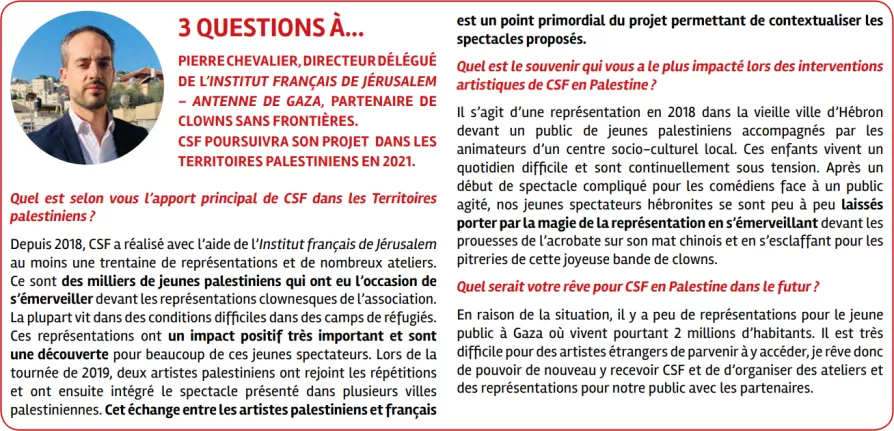
By bringing together partners from diverse backgrounds – humanitarian, institutional, private, and cultural – Clowns Without Borders France is able to develop comprehensive projects where everyone plays their part. For example, a typical mission might be funded by a corporate foundation, organized in conjunction with Doctors of the World on the ground, with the participation of local artists identified through the French Institute, and be featured in a report broadcast on the social media of a celebrity sponsor. This network of partnerships is coordinated professionally by the association, which has led to its inclusion in several official networks : it is a member of Coordination SUD (the national coordination of French solidarity NGOs), as well as the Children's Group , which brings together NGOs working for children's rights. It also belongs to the Clowns Without Borders International network, discussed below, which shares the experiences of the various national branches.
An international network of humanitarian clowns
Although autonomous in its management, Clowns Without Borders France has been part of an international movement from the outset, forming part of a network of sister organizations worldwide. It all began with the founding initiative of Tortell Poltrona in Spain in 1993, which inspired not only France but also other countries to create their own Clowns Without Borders branches. Clowns Without Borders International (CWBI) is now the informal federation that unites these various national branches. Based in Barcelona, where it all started, CWBI promotes coordination, the exchange of best practices, and the global visibility of the movement.
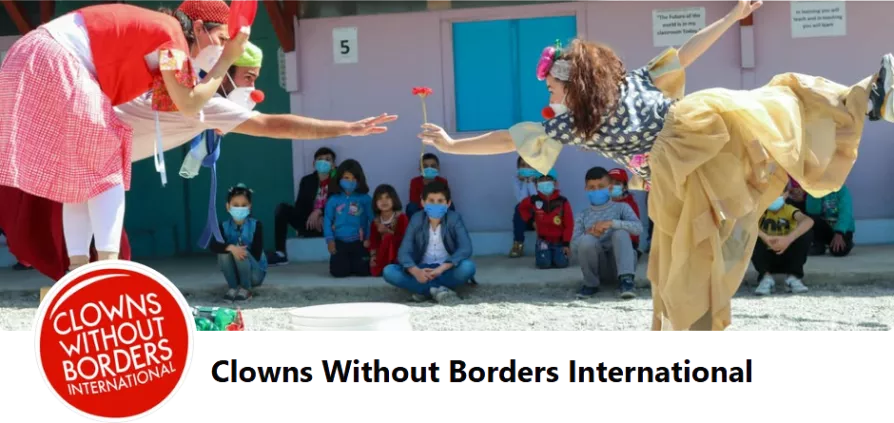
There are currently around fifteen active Clowns Without Borders chapters worldwide. Besides France and Spain, Clowns Without Borders associations exist in Canada (founded in 1993-94, it was one of the first after Spain), Sweden (Clowner Utan Gränser, created in 1996), the United States (Clowns Without Borders USA, launched in 1995 during a mission to Chiapas, Mexico), as well as in Belgium , Germany , South Africa , Australia , Ireland , Brazil , and elsewhere. Each of these entities is legally independent, but all share the same humanitarian mission and the same philosophy of volunteer engagement through art. The CWBI network facilitates regular meetings between these chapters (international assemblies, joint training sessions) and conducts joint advocacy on the international stage in favor of cultural rights and the rights of the child. Since 2015, Clowns Without Borders International has held consultative status with UNESCO, enabling it to participate in global conferences on arts education and peace. This recognition reinforces the idea that the model initiated by Tortell Poltrona has taken on a global dimension.
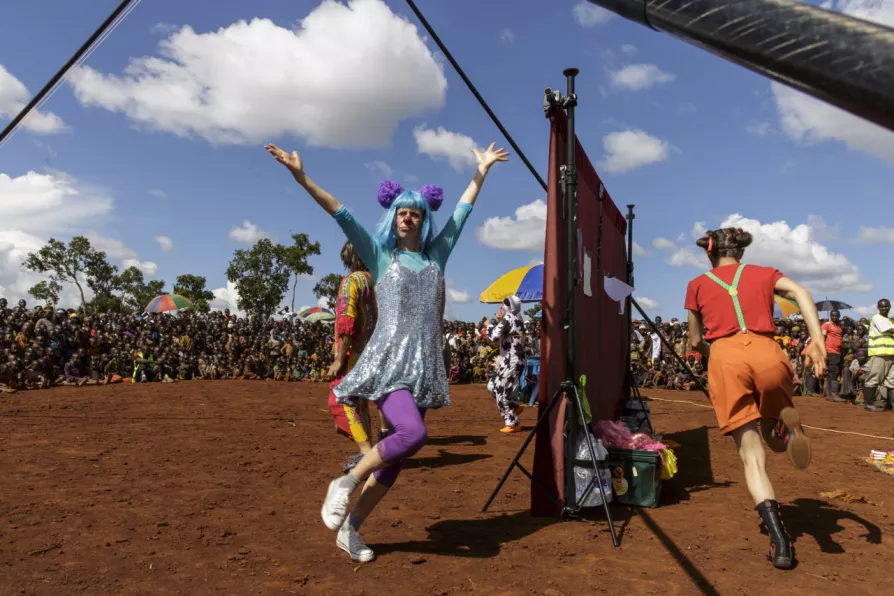
Collaborations between the different branches are frequent. Historically, as we have seen, CSF France's first mission in 1993 was a Franco-Spanish initiative in Croatia, just as in 1994 a Franco-Canadian mission traveled to the former Yugoslavia. Even today, mixed teams are sometimes formed for specific projects: for example, a clown from CSF Sweden might join a tour led by CSF Belgium in Greece, or CSF France might co-organize a project with CSF Canada in Lebanon. Information sharing is constant via CWBI, which maintains a calendar of missions for each country to avoid duplication and foster synergies. In the event of a major crisis, such as the 2010 earthquake in Haiti, the branches can combine their efforts: thus, after the earthquake, Clowns Without Borders conducted several tours in Haiti in 2010-2011 with the participation of artists from various countries, in partnership with NGOs like Terre des Hommes.
Each branch brings its own unique perspective, enriching the whole. The Swedes, for example, developed methods inspired by clown psychology to work with child soldiers in Uganda; the Canadians focused on training local clowns in the countries they visited; the Americans documented certain interventions (such as in Chiapas in 1996) showing how the presence of clowns can even help to ease tensions (it is said that a performance given to Zapatista sympathizers helped defuse a tense situation during peace negotiations). These experiences inform collective thinking.
Clowns Without Borders France maintains close ties with its Spanish and Canadian counterparts, given their shared history, as well as with Clowns Without Borders Sweden, one of its most active branches in Europe. In 2022, for example, CWBI France participated alongside CWBI Sweden and Spain in a European Union-supported project to promote children's rights through social circus. This type of international partnership demonstrates the cohesion of the CWBI network and its commitment to integrating humanitarian clowning into broader frameworks of international cooperation. Internally, CWBI also facilitates the sharing of resources (safety guides, ethical charters, impact assessments) and the adoption of common positions. The ethics and charter of Clowns Without Borders France, for instance, closely align with those defined internationally to ensure responsible humanitarian clowning practices.
Thus, while Clowns Without Borders France operates primarily with its own resources, it is never isolated. It belongs to the global family of Clowns Without Borders , united by the same red nose, a symbol of hope. This international network amplifies the reach of the slogan "Children without smiles, never again," making it resonate across all continents. It also provides the French association with a platform to advocate for its ideas with major institutions and to learn from others. Ultimately, this diplomacy of laughter builds bridges between peoples: Clowns Without Borders act as a kind of universal ambassador for the right to childhood.
Powerful testimonies and stories
Behind the figures and principles lie human stories that embody the work of Clowns Without Borders. A few emblematic accounts allow us to grasp the essence and emotion of these extraordinary missions.
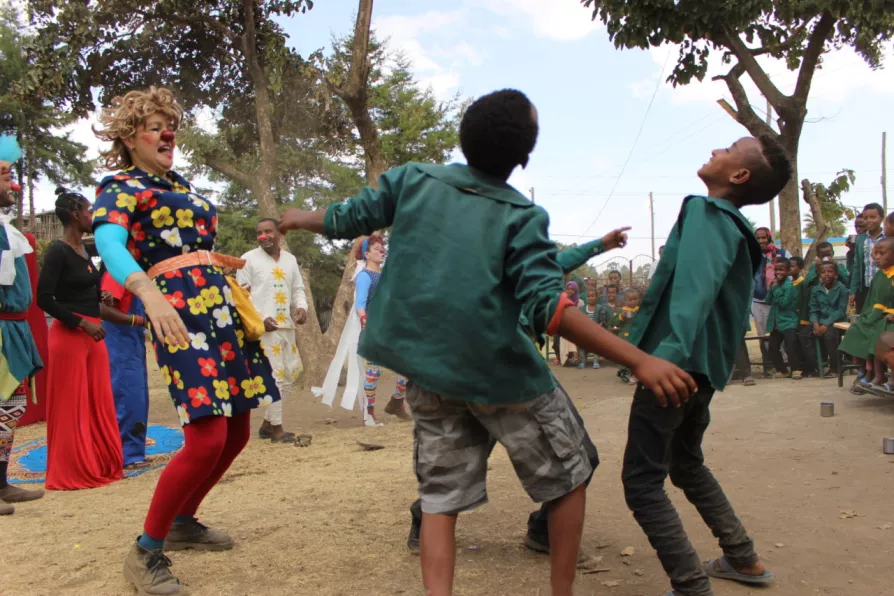
The founding anecdote is itself a beautiful testament to children's solidarity: in 1993, schoolchildren in Barcelona, learning that their pen pals from a Croatian school were living in a refugee camp and "had nothing left to laugh about," organized a fundraiser to send their favorite clown, Tortell Poltrona, to perform there. It was Spanish children who first had the idea of using a clown to comfort other children traumatized by war. Tortell, moved by this request, attracted more than 4,000 children to his show in the Croatian camp, triggering unforgettable bursts of laughter amidst the tents. The impact was such that the aid workers present realized how much "clowns and laughter were needed for populations in crisis." This moment crystallized the need for an organization like Clowns Without Borders. Tortell Poltrona likes to recall that, on site, a child simply said to him after the show: "It's been so long since we laughed, thank you." These few words alone justified the entire nascent undertaking.
Over the course of their missions, the clowns accumulate memories that are often deeply moving. In Macedonia, during the Kosovo crisis in 1999, a clown from the French team recalls a performance in an Albanian refugee camp: “At first, the children kept their distance, staring blankly. Then one of them smiled when he saw us acting silly, and all the others gradually came closer. By the end, they all wanted to touch our red noses, as if to check if they were real… and they were laughing uproariously.” This transformative power of laughter on a group of dejected children remains etched in her memory, as does the metamorphosis of the camp's atmosphere that day – even the parents were laughing as they watched their children playing again.
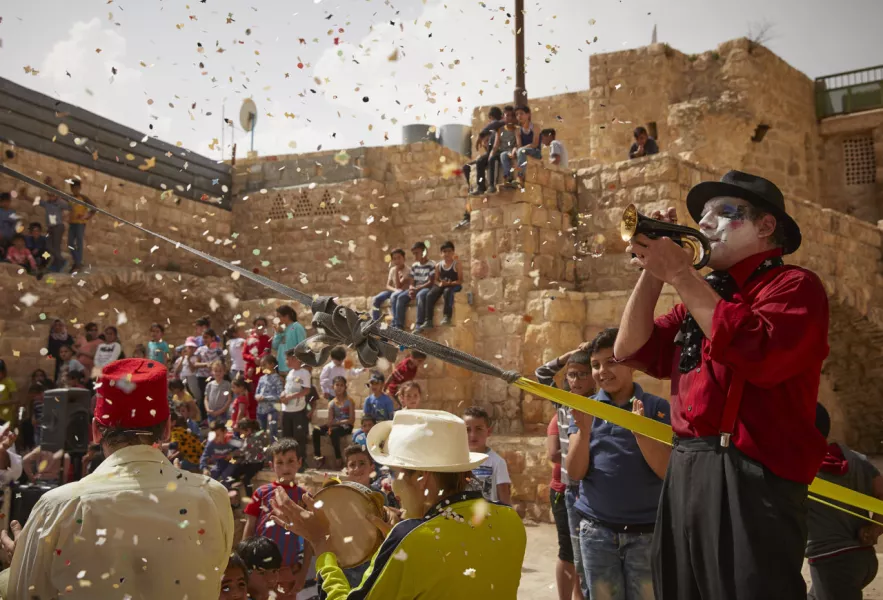
A different scene, a different continent: in 2017, in a remote village in Madagascar , the Clowns Without Borders team put on an open-air show with the help of the local band Telofangady . Isabelle, CSF's Malagasy partner, recounts that at the end of the performance, the villagers spontaneously broke into a group dance around the clowns: “The CSF artists and our local musicians danced hand in hand with the children and parents. We no longer knew who was the clown and who was the spectator. That day, the village rediscovered its former joy, and for a few hours, we forgot the drought, the poverty…” She emphasizes that since this visit, local teachers have incorporated more games and songs into their school, convinced by the experience of the playful benefits for children.
In France , there are also some remarkable stories. For example, during a workshop held in the Paris suburbs, young volunteers from shantytowns shared their experience: “At the beginning of the workshop, I barely dared to speak. And now, I’ve just clowned around in front of 50 kids who were laughing… I don’t even recognize myself!” one of them confided, smiling, proud to have overcome his shyness thanks to the project with Clowns Without Borders. Another added: “When I was little in Romania, I never saw a show. So, making French children laugh today, for me, it’s a kind of revenge.” These words demonstrate that the art of clowning can also positively transform those who practice it, in addition to those who watch – a valuable multiplier effect.
Among the clowns who have left their mark on the association's history is Malik Nahassia , one of the co-founders, who went on numerous missions in the 1990s and 2000s. He particularly remembered a tour in the former Yugoslavia where the team had to be escorted by UN peacekeepers to reach an isolated orphanage in Bosnia. "We were performing under the protection of armed soldiers; it was surreal… And these children, who had lost everything, laughed at my oversized shoes and my blunders. At that moment, I understood that our place was truly here, as close as possible to those who are suffering." This feeling of the artist's legitimacy at the heart of the crisis was expressed by many clowns afterward: far from feeling futile in the face of such horror, they felt they were providing unique support, complementing that of doctors and humanitarian workers.
We could tell countless stories: a red nose given as a gift to a child who never takes it off; a clown who makes a group of exhausted mothers laugh in a makeshift camp; or an impromptu performance in the rain in Bangladesh where the artists end up soaked but happy to see the audience dancing with them in the downpour. These stories, often recounted in the association's mission journals , nourish the legend and spirit of Clowns Without Borders. They remind us that behind every action, there are unforgettable encounters : those of human beings who, beyond the barriers of language and hardship, connect through laughter and shared emotion.
In conclusion, Clowns Without Borders France embodies a unique form of humanitarianism where the performing arts become a vehicle for healing the soul. Its history and operations demonstrate the seriousness and rigor applied to a poetic ideal: "to offer a bubble of laughter to children going through a storm." For circus and performing arts professionals, it is a prime example of what their art can contribute to society at large, even in the most challenging crisis zones. For the humanitarian sector, it is a reminder that providing assistance to populations is not limited to bread and shelter, but also encompasses culture, play, and hope . And for all of us, it is an invitation to believe in the universal power of laughter: a language without borders that, modestly but surely, helps to mend relationships and heal people. As one of the association's patrons, Yann Frisch, so aptly puts it , "Clowns celebrate something beautiful, mysterious, and sometimes healing: shared laughter." […] A possible way to heal the wounds of a bleeding world.”
Bibliography / Webliography
- Clowns Without Borders France – Official website : pages “Our mission” and “Our vision” (accessed in 2025). Information on the artistic mission, principles and history of the association.
- Coordination SUD – Clowns Without Borders France : NGO presentation sheet (accessed in 2025). Summary of the mission, methods of action, and advocacy of CSF France. (coordinationsud.org)
- Aurélie Billecard, LePetitJournal.com , August 6, 2023 – “Clowns Without Borders: Breaking down borders through laughter and solidarity.” A journalistic article presenting the actions of CSF (France and internationally), with quotes from the executive director and recent examples. (lepetitjournal.com)
- Viviane Poiret (CSF) interviewed on Le-Clown.fr, January 19, 2021 – “What is Clowns Without Borders?” A presentation for the general public of CSF's objectives (children who are victims of war, poverty, and exclusion) and its initial areas of intervention (refugee camps, slums, juvenile detention centers, etc.). (le-clown.fr)
- Nomadic Arts Blog, December 13, 2016 – “Clowns Without Borders – Make a donation!” A statistical overview of 2016 for CSF France (number of missions, beneficiaries, volunteer artists) and a call for support, illustrating the association's financial operations. (arts-nomades.blogspot.com)
- Wikipedia (French), article Clowns Without Borders (last updated 2025). History of the organization's creation (Tortell Poltrona in 1993 in Barcelona, Antonin Maurel for the French branch), with references to specialized sources (National Library of France, Journal des Arts). (fr.wikipedia.org)
- Testimony of Isabelle Marie (CSF's Malagasy partner) – published on clowns-sans-frontieres-france.org, 2020. An account of her experience working with CSF in Madagascar, highlighting the impact on children and the benefits of intercultural exchange for local partners. (clowns-sans-frontieres-france.org)
- Clowns Without Borders France – “Our Partners” page of the official website (accessed in 2025). List of key supporters (foundations, institutions, cultural associations, field NGOs) illustrating the association's diverse network of partners. (clowns-sans-frontieres-france.org)
- Clowns Without Borders USA , "About Us" page (accessed in 2025). This indicates CSF France's membership in the international CWBI network, which comprises 15 chapters worldwide. (clownswithoutborders.org)
- Clowns Without Borders France – Activity report and accounts 2019 (data extracted via Wikipedia).
Figures (annual budget, number of employees and volunteers) highlight the association's manageable size. (fr.wikipedia.org)




Geryon contact fire staff
Contact staff equipped with X-GRIP. Kevlar: 100mm.
Length: 1m50.

Fire contact staff - Gora
Staff Contact fire. Aluminum 7075. Kevlar: 100mm.
Length: 1m50.


Removable fire contact staff, aluminum or carbon fiber
Gora removable contact staff, 7075 aluminum. Kevlar: 100mm.
Length: 1.50m.

Comments
!Be the First to comment!
