School of Aerial Acrobatics and Dance
The School of Aerial Acrobatics and Dance (Σχολή Εναέριων Ακροβατικών και Χορού) is a school specializing in aerial acrobatics and dance, located in the Votanikos district of Athens, Greece. In partnership with the artist Evgenia Galeraki, it welcomes adults of all levels, from beginners to experienced dancers, for a progressive learning experience in suspension techniques, acrobatic movements, and physical expression. Its activities focus primarily on aerial rope work, aerial silks, and the exploration of various suspended apparatus. The school offers regular classes, open practice sessions, specialized workshops with guest artists, and intensive courses. Its teaching combines physical conditioning, muscle strengthening, flexibility, coordination, choreographic research, and the development of creativity. Through her training and artistic encounters, she contributes to the transmission of aerial arts and the development of a community of contemporary circus practitioners in Athens.
School of Aerial Acrobatics and Dance – School of aerial acrobatics and dance in Athens
The School of Aerial Acrobatics and Dance, in Greek Σχολή Εναέριων Ακροβατικών και Χορού , is a school dedicated to learning aerial acrobatics and the artistic exploration of movement.
Located at 7 Zirnovou Street , in the Votanikos district of Athens, it offers a practice space for people wishing to discover or deepen their knowledge of the aerial disciplines of contemporary circus.
The school is associated with Evgenia Galeraki , an artist and teacher specializing in aerial arts and dance.
Its activities include group classes , technical training, open practice sessions, intensive workshops and meetings with guest artists.
The disciplines include aerial rope , aerial silks and work on various suspended apparatus.
The teaching combines acrobatic technique , physical preparation, flexibility, body awareness and artistic expression.
A school specializing in aerial arts
The School of Aerial Acrobatics and Dance develops an approach to circus arts centered on disciplines practiced in suspension .
Participants discover the movement possibilities offered by aerial apparatus .
Learning helps to develop strength , coordination and body control .
The exercises include technical movements, acrobatic positions, and transitions between different figures.
Aerial practice also requires concentration and a good perception of space.
This specialization allows students to progressively deepen their knowledge of aerial circus techniques.
A practice open at different levels
The school welcomes people wishing to discover aerial acrobatics as well as practitioners who already have experience.
Beginner classes allow participants to become familiar with the equipment and basic movements.
More experienced students can deepen their technique and develop more complex sequences.
Progress is based on the acquisition of physical skills and the repetition of exercises.
The activities allow everyone to develop their practice according to their experience.
This diversity promotes exchanges between students of different levels.
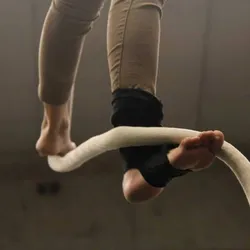
The aerial rope
Aerial rope plays an important role in the world of school.
This vertical apparatus allows for suspensions, acrobatic positions and movements at height.
The practice particularly requires the strength of the arms, shoulders and core.
Participants also work on coordinating and controlling their movements.
Aerial rope offers numerous possibilities for transitions and sequences.
It constitutes a technical discipline that can also be used in choreographic creations.
Aerial fabric
Aerial silks is also one of the disciplines practiced within the institution.
He uses long suspended strips of fabric to perform acrobatic movements.
Students discover different ways to rise, hang, and control their position.
The exercises help to develop strength, flexibility and coordination.
Movements can be combined to create fluid and expressive sequences.
Aerial silks is thus a practice that combines physical performance and artistic creation.
Exploring different pieces of equipment
The school offers activities that allow students to work on various types of aerial equipment.
This diversity encourages practitioners to discover different sensations of suspension and movement.
Each piece of equipment has its own technical constraints.
Participants develop their ability to adapt their support and coordination.
Exploring multiple media also helps to enrich creativity.
This approach contributes to a broader understanding of aerial arts.
Physical preparation
Physical preparation plays an important role in learning aerial disciplines.
The exercises help to strengthen the muscles used during suspensions and acrobatic movements.
The work focuses particularly on the shoulders, arms, back and core.
The preparation also helps to develop endurance and stability.
It supports technical progression on the apparatus.
Combining muscle strengthening and acrobatic learning allows for the development of a regular practice.
Flexibility work
Flexibility is an essential component of aerial practice.
The school offers exercises designed to develop body mobility.
The work allows for a gradual exploration of the range of motion.
Flexibility contributes to the execution of certain acrobatic positions and to the fluidity of transitions.
It also possesses an important artistic dimension in aerial dance.
Mobility sessions thus complement technical training.
The coordination
Aerial acrobatics require precise coordination of movements.
Participants must simultaneously control their support, posture, and movements.
Learning helps to develop a better awareness of the body.
The exercises also promote concentration and precision.
Coordination is a fundamental skill for progressing on suspended apparatus.
It allows technical movements to be linked into fluid sequences.
Aerial dance
Aerial dance combines suspension techniques with choreographic research.
Movements can be organized according to a rhythm, an artistic intention, or a musical sequence.
The practice explores the expressive possibilities of the body in space.
Participants discover how to combine acrobatic figures with dance transitions.
This approach helps to develop creativity and stage presence.
It constitutes one of the links between circus arts and contemporary dance.
Body language
The school places great importance on personal expression .
Aerial techniques can become a means of communicating emotions and artistic intentions.
The work focuses on the quality of movement, transitions, and the relationship with space.
Students discover different ways of interpreting the same figure.
Body expression enriches technical practice.
It also allows one to develop a personal artistic language.
Regular classes
The School of Aerial Acrobatics and Dance organizes courses for practitioners of different levels.
The sessions allow for the building of technical progress over time.
Students can practice fundamental movements and gradually deepen their skills.
The teaching combines physical preparation, exercises on apparatus and exploration of movement.
Regular training contributes to the development of strength, coordination, and body control.
The courses form the core of the institution's educational activity.
Free practice sessions
The school also offers free practice sessions, called Open Practice .
These time slots allow practitioners to dedicate time to their personal training.
Participants can revisit previously studied movements and deepen their sequences.
Free practice promotes autonomy and continuity of learning.
It also provides an opportunity to meet other enthusiasts of aerial disciplines.
These sessions complement group classes and specialized workshops.
Workshops with guest artists
The School of Aerial Acrobatics and Dance welcomes external speakers for technical and artistic workshops.
These meetings allow participants to discover different working methods.
Invited artists can propose particular approaches to movement, suspension, or creation.
The internships promote exchanges between practitioners and professionals.
They also contribute to enriching the students' technical knowledge.
The school thus participates in the circulation of know-how within the contemporary circus community.
Rope and fabric workshops
In October 2025 , the school notably announces a four-day workshop dedicated to aerial rope and fabric, with the artistic collective Instintos .
This meeting allows us to explore in greater depth the technical and expressive possibilities of vertical apparatus.
Working with rope and fabric offers complementary approaches to aerial movement.
Participants can explore different positions and transitions.
These specialized workshops provide an opportunity to enrich practice beyond regular classes.
The artistic encounters of June 2026
In June 2026 , the school hosts a seminar with the artist Tess Munro Pedreros .
The program includes two workshops entitled "Flow & Flourish" and "Aerial Alchemy" .
These proposals are dedicated to the artistic and technical exploration of aerial movement.
They allow participants to discover other choreographic approaches.
Meetings with guest artists contribute to the artistic openness of the school.
Summer internships
The school also develops intensive courses during the summer period.
These programs allow participants to dedicate more time to their practice.
The activities combine work on apparatus, muscle strengthening and flexibility.
The internships welcome people of different levels.
They offer the opportunity to discover new techniques or to deepen skills already acquired.
Group practice also promotes exchanges between participants.
Aerial Adults Camp 2026
From July 6 to 30, 2026 , the School of Aerial Acrobatics and Dance is organizing a workshop dedicated to aerial disciplines for adults.
The program includes activities on the apparatus, strengthening exercises and flexibility work.
Participants can discover various equipment and develop their skills.
The course is open to beginners as well as more experienced practitioners.
Teenagers can also participate after prior agreement.
This formula allows different profiles to come together around an intensive experience of aerial arts.
Summer 2026 activities
During the summer of 2026 , the school will maintain classes and training activities.
The July program combines regular classes, à la carte sessions, summer internship and free practice.
In August, activities continue in the form of sessions accessible on a per-unit basis.
This organization allows practitioners to continue their training during the summer period.
It also offers beginners the opportunity to discover aerial disciplines.
Technical progress
Learning aerial acrobatics is based on regular progression .
The students first learn the fundamental movements.
They then develop their strength and their ability to control positions.
Repetition helps to improve the precision of movements.
Participants can gradually combine several figures in the same sequence.
This progression helps to build a personal and sustainable practice.
Concentration and perseverance
Aerial disciplines require concentration and patience .
Each movement requires work involving understanding and repetition.
Students learn to recognize their progress and to continue their efforts.
Mastering a new technique represents an important step.
This experience contributes to the development of self-confidence.
Aerial practice thus combines physical learning and personal development.
Creativity
Artistic exploration is an important dimension of the school.
Practitioners can experiment with different ways of linking movements.
Choreographic work allows one to develop a personal style.
Music, rhythm, and artistic intention can enrich the sequences.
Creative exercises encourage the imagination.
They also allow acrobatic technique to be linked to a form of expression.
A community of practitioners
The School of Aerial Acrobatics and Dance is a meeting place for aerial arts enthusiasts in Athens.
Group classes, workshops and open practice sessions allow students to share their experiences.
Participants can discover new approaches and exchange ideas about their practice.
This collective dimension helps to create an artistic community .
Meetings with external speakers also enrich school life.
A space dedicated to aerial circus in Athens
Located in the Votanikos district, the School of Aerial Acrobatics and Dance contributes to the development of aerial disciplines in the Greek capital.
It combines technical instruction, physical preparation, choreographic research and artistic exchanges.
Its activities include courses for different levels, open practice sessions, intensive courses and specialized workshops.
Aerial rope, aerial silks and the exploration of multiple apparatuses occupy an important place in its identity.
Through its teaching and artistic encounters, the school participates in the transmission of contemporary circus skills and the development of a community of aerial arts practitioners.
