fire ball
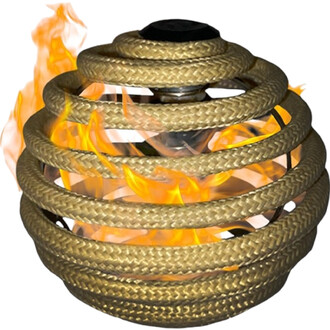
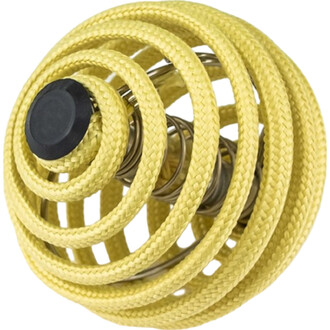
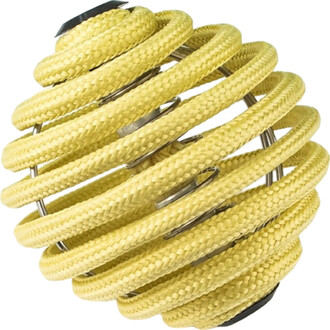
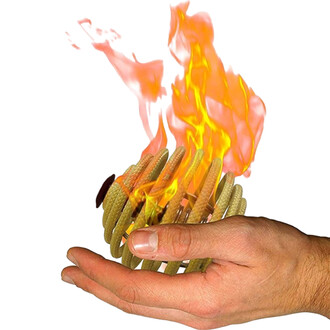
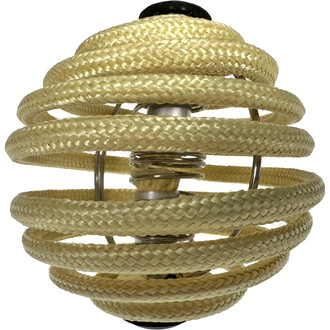
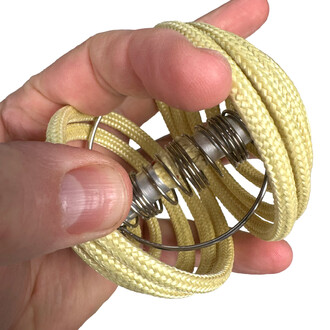
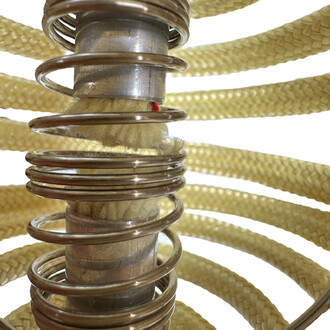
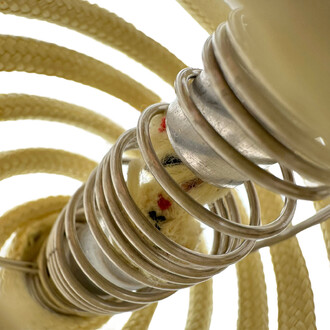
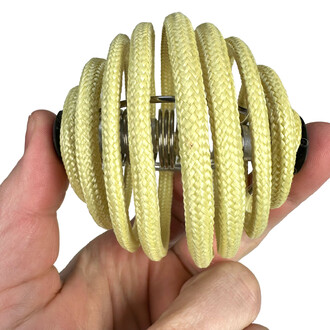
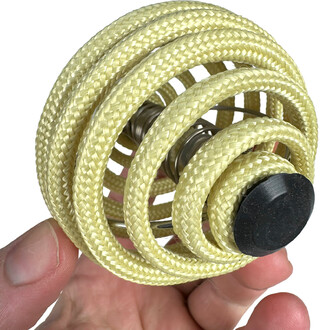
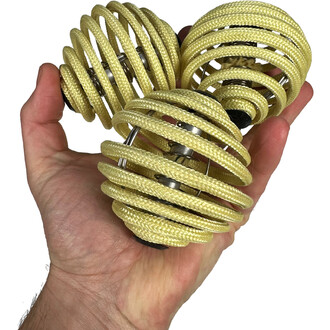
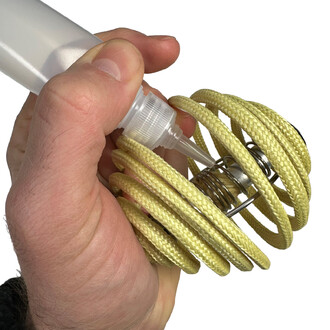
The "Cage" fire juggling ball is a high-precision accessory designed for manipulating fire with bare hands. Thanks to its stainless steel spring sheathed in Kevlar aramid, it allows for practice without gloves , provided that the ball remains in constant motion to dissipate heat by convection.
- You do not wish to dedicate time to meticulous preparation before each session.
- You don't want to respect a 20-minute cooling time between each ignition.
- You juggle occasionally without a technician to prepare your equipment.

Preparation and maintenance protocol
- Pre-moistening: Roll the outer sleeve in a little water (without touching the central wick). This prevents oil from being drawn in by capillary action and causing the heat shield to burn.
- Pipette filling: Only saturate the central wicks. Avoid any spillage onto the insulating Kevlar structure, as this will cause irreparable damage.
- Wick maintenance: The central Kevlar cord is replaceable, but the operation is meticulous to ensure perfect centering in the cage.
- Cooling: Allow 10 to 20 minutes between each session for the stainless steel structure to cool completely.

NetJuggler's review
"This ball is an incredible innovation for photography and stage work, but it's not forgiving. If you don't maintain constant movement, you'll burn the protective coating. If you don't keep it moist, it will catch fire. For those less meticulous, torches are preferable. For gear geeks, it's the ultimate accessory."
Fireball for photography
The absence of gloves frees up gestures and allows for dramatic portraits or unique physical interactions.
- Long Exposures: Ideal for capturing light trajectories without a visible background.
- Portraits: Use the ball as a direct warm light source on the subject.
- Silhouette Games: Spectacular rendering against dark backgrounds.
- Reflections: Impressive effects on water or mirrors.
Photo Warning: The ball must absolutely remain in motion, even during posing, otherwise the Kevlar will be destroyed in a single fixed shot.
Fuel Guidelines
The use of gasoline is strictly prohibited. Using the wrong fuel will immediately destroy the protective sheaths.
- Deodorized petroleum (Kerdane)
- Paraffin or lamp oil
- Barbecue lighter fluid (hot combustion)
- "Firewater" (if available)
- Gasoline / Gasoline (Risk of explosion)
- White spirit (Emits corrosive fumes)
- Alcohols / Methanol (Chemical destruction of Kevlar)
- Diesel (Harmful fumes and fouling)
Other contexts of use
- Cinema & Film: Accessory for close-up organic special effects.
- Teaching: Physical demonstrations on combustion and heat transfer.
- Fire Safety: Educational workshops on the safe handling of fire.
- Team Building: Highly supervised team-building activities.
Flames 'N Games Manufacturing
Specialists in fire equipment for live performances. Their "cage" balls are a benchmark for performers looking to eliminate the need for gloves in their costumes. Flames 'N Games was acquired by Oddballs, who have since improved most of the brand's equipment.
FAQ Fireball "Cage"
Why does the ball always have to be in motion?
Do we really have to wait 20 minutes between each session?
How do I replace the center wick?
Why moisten the outer sheath with water?
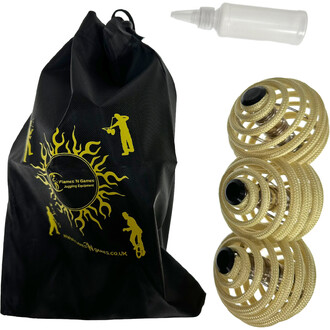
What is the offer for buying 3 balls?
Can you juggle if it's windy?
People who bought this item also bought the following items
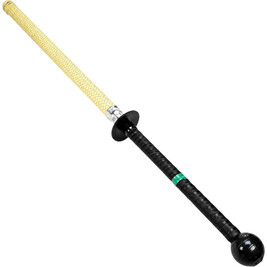
Fire Contact Sword
Épée contact feu pour artistes expérimentés. Centre de gravité optimisé, corde Kevlar® et grip silicone.
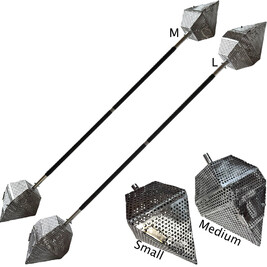
Sparkle Diamond Steel Staff
Spark effects for fire shows. Charcoal cages. Several sizes available.
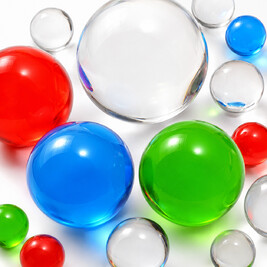
Acrylic ball
Discover Juggle Dream acrylic balls for contact juggling. Several sizes available from 60 mm to 120 mm.
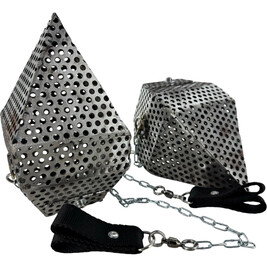
Sparkle Diamond Bolas - Sparkling Carbons
With charcoal cages. Sparks. Several sizes available.
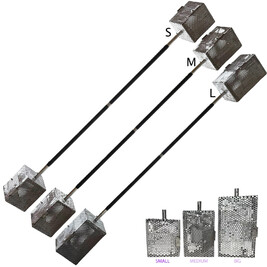
rectangular charcoal staff
Spark effects for fire shows. Coal cages. Several sizes available.

I bought this item and I'm a little disappointed.
The main reason is that it burns my hands a little with it. And to get a nice effect you have to use a big flame, so it's even hotter.
impregnating the middle wick is also a real headache, it already takes time, there is always gasoline that falls next to it so go on the spiral rope that we touch with our hands, but there is also the problem that I often end up with 1 ball more impregnated than another, or the opposite one badly done and almost not impregnated with gasoline, especially when I do it at night and I can't see much!
The duration of the flames is a bit limited too, but for me it wasn't a problem because my hands were too hot long before haha.
Lighting the flames is ALSO a problem, first you need a lighter with a long nozzle otherwise it's annoying, then since you light the first one before moving on to the others, the one that doesn't move tends to heat up the rope around it, personally I ask someone for help to make it move while I finish lighting the other two.
So a nice little wow effect to end a show/evening, but too much constraint in preparation, difficulty in having a constant and equal effect between the balls, and problems with heat on the hands when juggling.
Thank you very much for your detailed feedback. You raise several important points that deserve some clarification to help future users get to grips with this type of fireball:
🔥 Heat felt in the hands:
Fireballs do indeed give off a lot of heat, especially if the flame is too large. This is why it is essential not to overload the internal wick with fuel. A good initial saturation, achieved during the first successive lighting/extinguishing sessions, allows for well-proportioned flames, visually sufficient, but more comfortable to juggle.
💧 Problem with fuel leaking onto the external Kevlar:
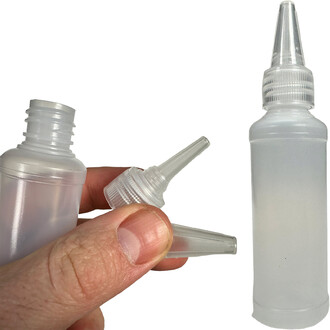
Indeed, it is important to master the impregnation of the internal wick without overflowing onto the external Kevlar (which only serves as thermal insulation). To facilitate this delicate operation, we strongly recommend the use of a small dosing pipette or a flexible bottle with a fine spout. This allows for precise dosing, avoids overflow and therefore limits excessive heating of the spring when in contact with the hands.
🌡 Balancing of the balls and homogeneous impregnation:
To achieve a consistent result between balls, it is advisable to work in full light and to clearly visualize the saturation level of each strand. In low light conditions (night, backstage), the pipette is again a great help to dose regularly and avoid gaps between balls.
🔥 Lighting the 3 balls:
Your point is very relevant. To facilitate the ignition of several balls in a row, it is recommended:
to use a lighter with a long nozzle,
to keep each ball in slight movement as soon as it is lit, to avoid localized overheating,
or actually call on an assistant, as you do, to keep the balls spinning while the next ones are lit.
⏳ Duration of the flames:
Indeed, these balls are intended for short, spectacular sequences at the end of a performance. They are not designed for long, continuous performances, but rather to generate an intense "wow effect" over a short period of time.
We 100% agree with you that these balls are full of constraints to do repeated sessions with them. I don't know if you read the paragraph in the product description titled "This ball is not for you", I invite you to read it if you come back here!