Thetys pulley

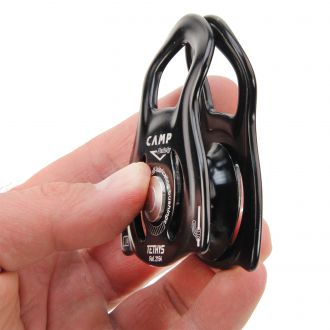
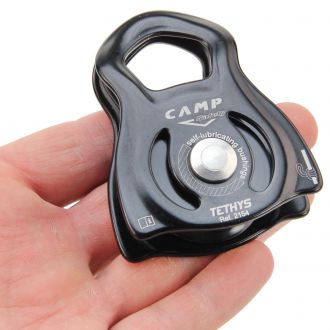
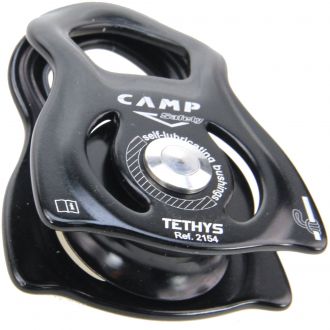
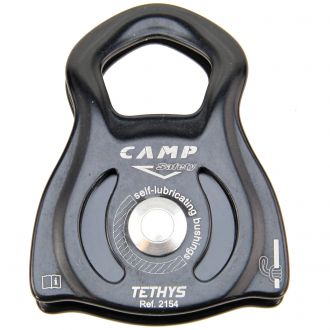
Item sold individually, without carabiner .
Tethys Pulley Information:
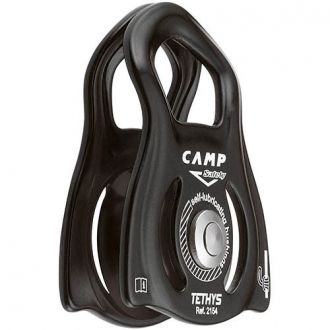
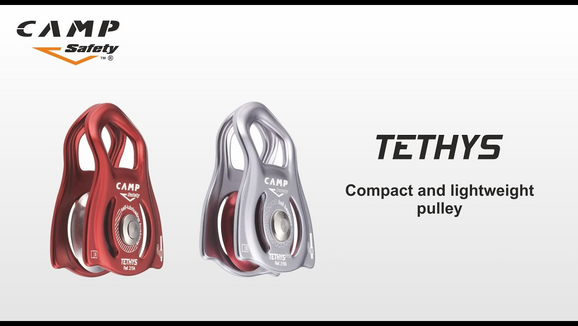
Pulley from the manufacturer CAMP, designer of mountain equipment, from the SAFETY range, reference 2154.
Tethys Pulley:
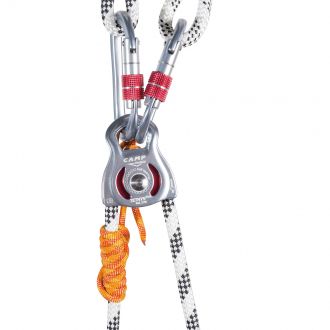
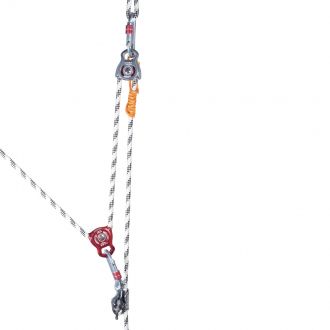
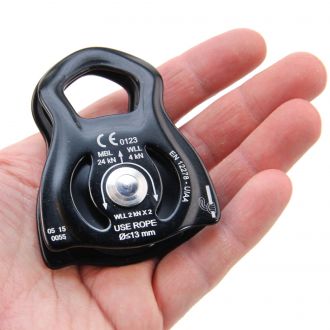
Compact and lightweight pulley. Movable side plates, fixing hole for two carabiners . For ropes up to 13 mm . Can be used with a self-locking knot that can be installed on one side. Rotation on self-lubricating bronze bearings: ideal for low use at low speed. Efficiency: 80%. Body and sheave in aluminum alloy, stainless steel axle.
NetJuggler's review of the Tethys pulley:
Notice in French.
Technical characteristics:
- Weight: 100g.
- Self-locking knot type: Prusik.
- Breaking load: 24kN.
Tethys Pulley Video:

People who bought this item also bought the following items
19€00
18€05
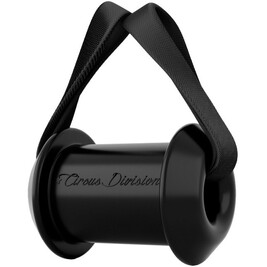
Anchor strap / Truck Loop
Relay, mooring or extending an anchor point (Tubular). 60cm / 80cm / 120cm / 160cm
50€50
45€45
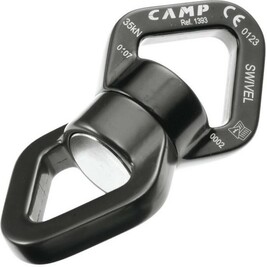
Swivel - CAMP
Swivel to prevent twisting and mixing of fabric or ropes. Swivels when loaded.
24€40
24€40
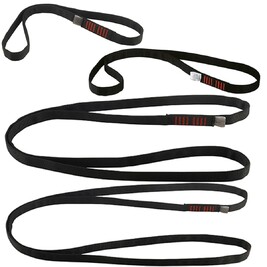
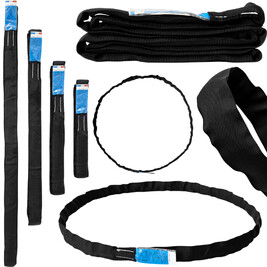
Circular sling
Relay, mooring or extending an anchor point (Tubular). Available in: 2m, 3m and 4m.

Is it designed for pulling equipment?
Good morning,
The pulley is designed to support up to 24kN.
A force of 24 kN (kilonewtons) is equivalent to 24,000 Newtons, which is a breaking load or pressure of approximately 2,447 kg (2.45 tonnes) under the effect of Earth's gravity.
You should therefore be able to pull your equipment without any problems :)
Thank you for your reply. With only one pulley and a rope, isn't it likely to be too heavy to raise and lower the apparatus with a person on it?
Thank you for your feedback. Indeed, with only one fixed pulley, you don't benefit from a multiplication of force: the pulley essentially serves to change the direction of traction. The weight of the person and the apparatus must therefore still be taken into account for the ascent and especially for the descent and its control. However, in light of your questions, I would like to draw your attention to an important point: **your project involves lifting and lowering a piece of equipment with a person on it.** This is therefore an assembly that directly impacts a person's safety.** The resistance indicated on the pulley we sell is not sufficient, on its own, to determine if your installation is safe and suitable. The entire system must be taken into account: anchor points, pulleys, rope, connectors, braking or descent system, dynamic loads, safety factors, equipment compatibility, etc. This type of design and validation falls outside our area of expertise. **Therefore, we strongly advise against attempting this assembly on your own if you do not already possess the necessary technical knowledge.** We recommend that you be accompanied by a **professional rigger / technician specializing in aerial rigging and personnel lifting**, who can study your installation as a whole and advise you on the appropriate equipment and assembly. We can of course provide you with information on the technical characteristics of the equipment we sell, but we cannot remotely validate a system designed to lift or lower a person. In this field, a design error, even with sufficiently robust individual materials, can have very serious consequences. Thank you for your understanding and please be careful with this type of installation.
Thank you for your reply! Don't worry, I'm just asking around.
Therefore, with this pulley, without any pulling (it is not used to raise or lower the apparatus, the rope remains fixed), and with a certified anchor, the setup would be:
Anchor → pulley → rope → aerial apparatus → person on top
In this configuration, is the pulley well designed and suitable to support the apparatus with a person on it, even without movement or pulling on the rope?
Thank you in advance for your clarification!